




A Concept Describing the Realities between War and Peace and its Impact on Latin America
Martin Leiner
The following paper examines frozen conflicts, a concept developed by Reconciliation Studies that expands on common themes from Political Science.[1] In general, Political Science describes “frozen conflicts” as armed conflicts ending, not in victory or peace agreements, but in a ceasefire owing to a stalemate on the front, international intervention, or both. The UN Blue Helmet missions in Cyprus, in 1964, and Rwanda, before the 1994 genocide, are examples of frozen conflicts after international intervention. The discipline of Reconciliation Studies has enlarged the concept of frozen conflicts. Reasons for this expansion and its possible impact on Latin American conflicts will be developed in these five sections:
- Reconciliation Studies—The Perspective
- Frozen conflicts—The Concept
- Case Study 1: Chile
- Case Study 2: Colombia
- Conclusion
1 Reconciliation Studies—The Perspective
1.1. History of Reconciliation Studies
Reconciliation Studies emerged in the 1990s for at least six reasons:
- German reunification would not have been possible without the reconciliation policy adopted by West Germany in the 1950s. During negotiations, countries like France, the UK, and Italy clearly expressed a persistent fear that a strong Germany in the middle of Europe would pose a danger. The necessary agreements were made possible by the trust of other countries —such as Spain, the USA, and the USSR under Michail Gorbachev— West Germany’s traditional conciliatory foreign policy, and, of course, the unique historical situation. This resulted in an increased interest in the study of reconciliation processes and the idea that the German experience could serve as a model for Korea and other countries.[2]
- Even more effective were the relatively successful stories of reconciliation efforts in Latin America, South Africa, Rwanda, Northern Ireland, and other parts of the world. Those accomplishments led to the development of a vast number of scientific studies adopting the perspectives of many different disciplines.
- With the exception of the Northern Ireland case, Truth and Reconciliation Commissions (or commissions with similar names and functions) have become important institutions in those processes. In response to complex legal issues after changes in the judicial system, transitional justice (TJ) was created as a research field in the 1990s. Although transitional justice is not necessarily motivated by the search for reconciliation, the concern for the rule of law and the promotion of human rights can be framed within a conciliatory approach. The research conducted by transitional justice scholars contributes substantially to understanding the success and problems of reconciliation processes, especially since transitional justice began encompassing topics like trauma therapies and memory culture, which are much closer to reconciliation than to the legal discipline.
- The end of dictatorships in Latin America, Africa, the Middle East, and Eastern Europe has evinced the important role of civil society, bottom-up processes, and religious actors. The latter often used the term “reconciliation”, which is particularly motivating for Christian and Jewish activists. However, it has also become integral to the discourse of Buddhist leaders, such as the Dalai Lama and Thich Nhat Hanh, appeared in the works of Muslim scholars such as Mohammed Abu-Nimer.
- Its potential for conflict prevention. Reconciliation aims at a change in ethics and habitus, and, in the words of UNESCO, it can be described as a culture of peace and global understanding. A serious mistake of international politics is its focus on the reaction to violent conflicts, rather than on the creation of a culture of peace and mutual understanding.
- The need to adopt a reconciliation approach and to overcome the focus on conflict resolution has been stressed by Daniel Bar-Tal, along with other Israeli and American social psychologists and political scientists[3] who coined the term “Intractable Conflicts”. Intractable conflicts cannot be resolved only by negotiation either because of the concerned population’s socio-emotional infrastructure, which leads to votes against peace treaties, such as in Cyprus (2004) and Colombia (2016); or due to changes in government, like in Israel after the murder of President Yitzhak Rabin (1995). The most dramatic effect of an intractable conflict occurred in 1994, when, after the first Arusha peace agreement for Rwanda, President Habyarimana was killed when a missile hit his plane, immediately sparking the genocide. Populations must be prepared for a peace achieved through reconciliation.
The origins of Reconciliation Studies should be kept in mind to understand their approaches and practical use.
1.2. Definition of Reconciliation Studies
The definition of Reconciliation Studies is controversial. Nevertheless, the field tends to be defined as scholarly research on the establishment of “normal” and, if possible, “good” relationships after, during, or to prevent serious incidents such as international or civil war, dictatorship, genocide, forced displacement, colonialism, and other human rights abuses. Reconciliation Studies aim to create a better description of these processes and a clearer understanding of success and failure factors. This definition requires some development.
1.3. Methodology of Reconciliation Studies
The terms “normal” and “good” do not imply any normative decision made by the researcher. Hence, they do not give rise to the common criticisms against both adjectives, being employed in a different sense. Methodologically, Reconciliation Studies focus on the self-assessment of those concerned with the degradation or destruction of relationships due to serious incidents. The words “normal” and “good” are therefore written with quotation marks. The goal is that all people affected by violence and human rights abuses, whether as victims, perpetrators, or somewhere in between, should opt for establishing a relationship with the other side. They might call it “normal” if it is approximately equivalent to other relationships they have with groups who have not committed acts of violent aggression or human rights violations. Talking about “good” relationships expresses a positive attitude towards former enemies. The successful reconciliation process between the French and German peoples after the World Wars and the Nazi occupation of Northern and Western France provides a clear example. Despite all individual and recent historical differences, the relationship between the French and German peoples is considered similar to the relationship between the French and Spanish or Polish peoples. Therefore, it is considered “normal” but also “good”, which is important because, for a society with multiple negative relationships, “normality” in the sense of “equivalent to others” would not indicate any reconciliation. However, the term “good” needs further methodological clarification. One question is, for example, whether it should be used solely as an indication that the relationship is positive and not negative, or whether the entire range of subjective understandings of “good” should play a role.
Besides the subjective approach of Reconciliation Studies, there is also an objective approach, which tries to define external and observable criteria for reconciliation, such as frequency of invitations, or internet communication research on social media (positive reactions to posts by the other group, common membership in Facebook groups, and so on). The dominant and indispensable approach, however, is subjective, both qualitatively and quantitatively. Qualitative research often examines the complexity and specific elements of relations. Thus, in Reconciliation Studies, the hermeneutical and interpretative element is as necessary as quantitative methods, such as surveys, questionnaires or quantitative data analysis.
These clarifications mark a breakthrough for Reconciliation Studies, refuting the past claim —made by sciences such as Social Psychology— that measuring reconciliation is impossible, and that only proxies such as “willingness to reconcile” are measurable. This development is of major importance, because any term which cannot be measured directly is relegated to a more or less precarious place in empirical social sciences.
1.4. Reconciliation as a Long-Term Process
This definition also implies that reconciliation is not an ideal goal or a momentary emotional event —as important as both may be— but a long-term process comprising several generations. For example, more than 50 years after the end of World War II, during the financial crisis in 2008, the crimes of Nazi occupation in Greece resurfaced as a public topic. The public transport in Athens featured pictures from the Nazi occupation period. German government officials such as Chancellor Merkel, who had made statements about the lack of working and taxpaying morals in Greece, had to face a reality almost forgotten in Germany. In Greece, however, the memory of more than 100 martyr villages, where German soldiers had committed mass shootings and burned innumerable houses down, is much alive. Between 1941 and 1942, at least 100.000 —and possibly up to 450.000— Greeks died by starvation as a consequence of German occupation policies. This episode is known as the “Great Hunger” in Greece, and its memories have been triggered by the German call for austerity measures. Also, we should not forget that Nazi Germany forced the Greek National Bank to grant Germany a loan that has not been paid back to this day. All this calls for a new German-Greek reconciliation process that includes the foundation of German-Greek youth organizations and statements of apology by German State officials in Greek martyr villages. It also evinces that, for half a century, some issues have been sidetracked and that the conflict between Greece and Germany has been frozen by political refusal to address it. This case not only shows that reconciliation is a long-term process but also provides an example to explain why Reconciliation Studies expanded the concept of frozen conflict.
1.5. Practices for Reconciliation and Transdisciplinary Approaches
Another consequence of this definition is that reconciliation processes touch on many aspects: political, social, ethical, cultural, media-related, legal, educational, economic, psychological, medical, religious, anthropological, and philosophical, among others. This is an open, non-sequential list of reconciliation practices:
- Treaties, legal provisions, diplomacy, classical conflict resolution
- Common security structure
- Apologies, reparations, common mourning
- Generalized cooperation
- Specific cooperation (city twinning, partnerships, common activities)
- Confrontation with history
- Humanizing the image of the other
- Change in the discourse of intellectual and religious leaders
- Trauma therapies as well as psychological and medical therapies
- Intergenerational work (e.g., schoolbook reform)
- Forum to discuss multiple visions of justice and peace
- Assisted and ritualized reintegration of perpetrators
As reconciliation is such a multi-layered reality, it needs transdisciplinary research, integrated with a hermeneutical philosophical approach. For the concept of frozen conflict, this means that the factors for freezing or unfreezing a conflict come from a combination of aspects. In the Greek case, education played a role, as German school curricula are still lacking information about the Nazi occupation crimes. With some important exceptions —such as the work of the Orthodox Academy in Crete or ecumenical encounters between the Greek Orthodox Church, and the Protestant and Catholic Churches in Germany—, the topic has been more or less absent for a long time. Unlike other reconciliation processes, like the Polish-German case, churches have not played an important role in the German-Greek reconciliation process. There was also a social factor involved. Many of the martyr villages were accused of sheltering communist partisans. During the Greek Civil War, some of the World War victims were ostracized within the Greek Cold War society. International law further complicated the situation, prolonging the frozen conflict rather than promoting or advancing reconciliation. Although many Greek and German people moved on to develop good economic and political cooperation or had pleasant personal encounters during holidays or employment periods abroad —especially Greek workers in Germany—, the conflict still remained latent.
Multidisciplinary research on reconciliation reconstructs all those different areas and develops a complex understanding of the freezing and unfreezing of conflicts. Most freezing processes feature one prominent element; in the German-Greek case, this has been economy-oriented politics. German politicians were afraid of claims made by many Balkan and Eastern European countries demanding reparations for war crimes committed by German soldiers during World War II. They did not —and still do not— want to open what they call a “Pandora’s box”. Working comparatively with a global approach, Reconciliation Studies underline the specificity of each local process. For Latin America, every conflict requires a specific analysis concerning frozen conflicts; this will be offered in the third and fourth sections. However, general aspects of frozen conflicts are present in many places around the world.
1.6. Reconciliation and Peace
One more explanation concerning the definition of Reconciliation Studies must be provided. For this purpose, two aspects should be mentioned:
- If reconciliation is the process, peace appears to be the goal.
- Reconciliation helps to clarify the meaning of peace.
In any given conflict, different actors have different concepts of peace. Some associate peace with security, while others consider peace to be real only when larger security measures are no longer needed; some see constant and intensive democratic participation as a necessary element of peace, while others might focus on the rule of law and the application of the constitution; some might see peace only in the separation from another state and the building of a new independent state, while others might focus on preserving a country’s unity. Indigenous people might see a much more spiritual side of peace — peace with the land, holy places and objects, rivers, mountains, trees, animals, and the entire ecosystem. Others might need to understand this worldview first to accept it and find common solutions to these issues. Peace cannot be a consequence of imposing only one vision. There must be a true consultation about the different peace-s[4] people are aiming at, which should include not only the various concepts but also previous experiences of peace. The goal is to come nearer to a reconciled peace, one that is inclusive for all.
There is another element to be observed: peace and reconciliation stand for qualities of relationships. There are five kinds of relationships that must always be respected:
- Reconciliation with the Other (the enemy) as a diverse reality (different people, groups, or individuals, changing over time).
- Reconciliation with oneself is also a diverse and changing reality, as attested by internal dialogue and moral consciousness reactions. For many people reconciliation with oneself is the hardest.
- Reconciliation with our own group. This group is diverse as well, and it is often a major force against reconciliation, threatening and excluding reconcilers as traitors, and influencing those who show a willingness to reconcile by appealing to bonds of loyalty and identity (often built against the inimical Other).
- Reconciliation within human and natural environments. The human environment can include third parties who react to reconciliation processes. They may consider reconciliation as a threat to themselves and take action against it. The natural environment is often a victim of military conflicts and economic interests.
- Reconciliation with God, transcendence, values, and senses of life. Traditionally, reconciliation has always been closely related to religion. People have to reconcile when breaking taboos and rules or committing sins.
In cases like that of Germany and France, we can say that, to a great extent, peace is a reality. A closer look reveals that, even in this case, some problematic issues that may potentially resurface can be still discussed. Corinne Defrance and Ulrich Pfeil[5] underlined that confrontation with history has open questions yet. The simple fact that, after World War II, Germany did not sign a peace treaty casts some uncertainty over many agreements reached after 1945, because even in 1990 —after the German reunification— these agreements were not recognized as equivalent to a peace treaty. In many conflicts around the world, however, it is clear that peace is yet incomplete; Colombia, for example, has not only a decades-long history of wars, but also a history of peace-making which is almost as long as those wars. Until today, the result has been imperfect peace. In those cases, Reconciliation Studies is closer to concepts of imperfect peace, such as those developed by Granada-based researcher Francisco Muñoz.[6]
1.7. The Hölderlin Perspective
Reconciliation Studies as we are practicing them in Jena have a certain tendency to see peace as being pre-existent, always present and growing. Consequently, we tend to think that peace begins in the middle of a conflict and evolves with it. This is known as the Hölderlin perspective, after the passage in Hölderlin’s novel Hyperion or The Hermit in Greece (Hyperion oder Der Eremit in Griechenland): “Reconciliation is in the middle of strife and all things divided find each other again” (“Versöhnung ist mitten im Streit und alles Getrennte findet sich wieder”). It is not with friends that we make peace and reconcile but with enemies. This means that reconciliation must start during the conflict itself, where some people find some hope for peace. The Hölderlin perspective also implies that reconciliation and conflict are always co-existent. Reconciliation works on the conflict and transforms it, always having to deal with it.
Conflicts are thus not negative in themselves. On the contrary, they are forces for social change that keep social life alive. The main problem is that, too often, conflicts are dealt with destructively and violently, instead of being seen as chances to create a new and better common life together. Conflicts do not only separate but also bring people together in a very intense way, although they often lead to opposing parties becoming enemies that seek to avoid any future contact with each other.
Given the Hölderlin perspective and the reality of imperfect peace, reconciliation studies started to develop a new vision of conflicts wherein the concept of frozen conflict is central.
2. Frozen Conflicts — The Concept
2.1. Different Forms of Frozen Conflicts
As already pointed out, Reconciliation Studies enlarge the concept of frozen conflicts. Frozen conflicts do not appear only in military contexts — they might also be:
- Military, as a result of armed forces controlling front lines and preventing further violence outbreaks.
- Legal, as a result of barring appeals to court. Non-member states (like the USA) or those that have repealed their International Criminal Court membership (like Rwanda) produce legally frozen conflicts. Other examples are denying the right of individuals to sue states or introducing laws that hamper any progress, for instance, unilateral decisions to rule out justice claims. The legal principle of ne bis in idem, according to which no case should be brought to trial twice, easily leads to conflict freezing, especially if the (first instance) court decision is considered fundamentally unjust by one side. On the other hand, that rule can either promote reconciliation or lead to a violent conflict, as in cases of manifest police violence whose perpetrators were not found guilty by US courts.
- Political, as a result of political elites neglecting the issue and refusing to do anything for reconciliation or to resolve the conflict.
- Economic, as a result of the socio-economic situation perpetuating discrimination against victims of violence, as in post-Apartheid South Africa and other postcolonial African states.
- Social, as a consequence of the separation of populations, hindering communication and association for common action. Social freezing can also be considered a more general concept according to social psychologist Kurt Lewin’s three-phase theory of social change, which describes societies as usually frozen and not open to change. To effect organized changes within German society, in the context of post-Nazism re-education efforts, Lewin had suggested proceeding on three steps: unfreezing, change, and refreezing on a different, democratic level.[7]
- Cultural, as a result of two societies living in different cultural worlds, speaking literally or de facto different languages, and having different religious and cultural references. A city like Belfast was —and partly is— not only socially but also culturally divided. Catholics and Protestants support different football clubs, read different authors, consume different media, go to different churches and different schools, and take different positions in international politics.
- Private, as a result of a tacit agreement to silence an issue, to forget the past, or at least to live as if it has been forgotten. This happens frequently in conflicts within couples and families, and it may become a general attitude after military dictatorships.
These modalities are often combined, and the list is not final — conflicts may freeze for other reasons.
2.2. Positive Sense and Negative Results of Frozen Conflicts
From an ethical point of view, different evaluations of freezing conflicts are possible. There are cases in which freezing a conflict is the only way to prevent mass killings or to avoid unending problems to cooperate. Freezing a conflict can also make sense to take a break and discover new orientations. However, some freezing processes (1) hinder social development, (2) have high costs, and (3) create so-called intractable conflicts with an explosive socio-emotional infrastructure.
(1) Frozen conflicts always hinder social development. Kriesberg explains that “A social conflict exists when two or more persons or groups manifest the belief that they have incompatible objectives.”[8] The causes of incompatible objectives must be taken into consideration to understand the conflict on a deeper level. Incompatible objectives have two main causes: different “needs”—including some which might be seen as ethically unacceptable, such as the need to impose power or control over others, and greed—; and different justice claims — which might also be more or less acceptable. Even needs are often formulated as justice issues. The emergence of a conflict proves the need for discussions and clarifications about common life and social ethics. Conflicts can therefore help societies to evolve towards a better common life and guarantee more justice for everybody.
(2) When those discussions and changes are avoided or violently suppressed, a frozen conflict structure is established. This leads to deeply divided societies and to opposition, and later enmity, between countries. These are characterized by high levels of mistrust, dualistic worldviews, frequent demonizing of others, etc. Justice and even revenge become central, levels of hope are low, and people tend to believe that talking to the other side is impossible. Identity constructions become increasingly based on nationalist approaches — differing from the enemy and opposing them become an important part of group identity. Like in wars, identities are framed as an antagonistic dualism based on the enmity of the other group. All that is considered good is attributed to one’s own identity, while all that is considered bad becomes part of the stereotype of the other. These exaggerated representations convey the impression that conflicts concern identities. As a matter of fact, conflicts usually begin over needs, wishes, and justice. As soon as the issue of identity arises, it defines the groups, sets them against one another, and creates new needs and wishes, such as living in circumstances that render unnecessary any cooperation and compromise with the enemy group. If the freezing process goes further, larger parts of the population tend to sympathize with spoilers, which often leads to a rise of populist and authoritarian politicians on the governments’ side and to violent groups on the non-governmental side. Populist and authoritarian politicians and violent opposition are mutually reinforcing, triggering a downward spiral that will likely lead to a breakout of violence. When considering Friedrich Glasl’s classical 9-step model of conflict escalation,[9] we can see that, in a frozen conflict, the way down can occur between steps 3 and 6. In step 3, there is still debate and the conflict is not yet frozen. However, from step 7 on, a frozen conflict turns into a hot conflict.
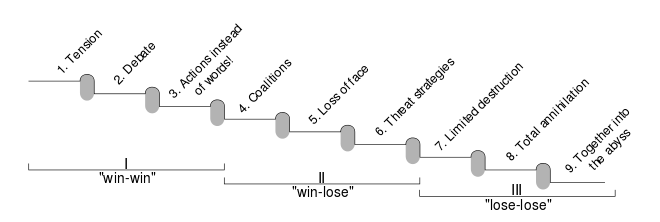
Copyright: Wikipedia Commons.
We can consider the Israeli-Palestinian conflict as an example. Since the official end of the Second Intifada, following the Sham-el Sheik ceasefire agreements in 2005, the Israeli-Palestinian conflict has become a mainly frozen conflict oscillating between step 3 —with actions such as building settlements or boycotting Israel— and step 7 —with limited destructions of houses or attacks from both sides in Gaza. When approaching step 7, it turns from a frozen conflict into a hot conflict. This only lasts a few weeks, and the conflict freezes again.
The Israeli-Palestinian conflict is frozen not only by military action, but also by social separation (e.g. the wall and the Israeli interdiction that forbids citizens to enter Area A cities). This conflict is a clear example of the high security costs of a frozen conflict, leading to a loss of economic cooperation benefits for the majority of the population, a system of checkpoints and military rule in Areas B and C of Palestinian territories, and a constant militarization of both societies —including a three-year military service for men and a shorter military service for women in Israel, and the active role of generals in public and political life and education in both societies. The entire international community is divided between Israel’s allies and the supporters of Palestine’s boycott policy. For the elites in both countries, however, the economic balance looks different. The conflict may not mean a loss of benefits for them, as its continuation rewards politicians with international attention and both sides with huge transfer payments financed by taxpayers from abroad—such as the USA for Israel, Qatar for the Gaza strip, and many European and Arab countries for the Westbank and Palestinian refugees. The Israeli-Palestinian frozen conflict can be regarded as a strategy that responds to economic rationality for the elites of both societies. This also explains why, in the last two decades, those elites have made no serious attempt to resolve the conflict. For the general population, however, the freezing of the Israeli-Palestinian conflict is far from being a road to peace and prosperity — on the contrary, it emphasizes walls, encourages the use of arms, and hinders the construction of the Palestinian local economy.
The Israeli-Palestinian situation also shows the conflict-winning strategy of exhausting the other side by degrading their living conditions and pushing people to emigrate. Israel’s strategy to get stronger may be promoting the growth of its population. This strategy works through the creation of multiple realities in order to argue for their international and national reputations. Frozen conflicts can easily build acceptance for pro-conflict politicians, and also for populist and authoritarian approaches to their resolution. In cases of crises, the threat of the enemy can always be evoked by starting limited wars. The ultimate goal is to harvest a more or less complete victory or at least to maintain certain privileges. Freezing a conflict slows down or completely interrupts a process where different objectives can come together into a common new arrangement. Instead, a frozen conflict grants power to those who control and manage the freezing factors, such as populist politicians, the army, and the secret services.
(3) The Israeli-Palestinian conflict is the classical example of an intractable conflict in Bar Siman-Tov’s book. This conflict has a socio-emotional infrastructure which results in a situation where agreements cannot be implemented. The theory of frozen conflicts would rather say that the conflict is not per se intractable but that it has become frozen on a quite hostile level.[10] As a consequence, the possible solutions —which do exist— are not likely to be chosen by the elites on both sides.
The most important practical issue about frozen conflicts is whether they are used to create a better relationship between both sides —furthering reconciliation processes— or a worse relationship. Cold War relationships are a good example of frozen conflicts during which many practices of reconciliation have been adopted, starting from the 1960s and going on into the 1980s. This does not mean that all relationships between member states of the Warsaw Pact and NATO fostered peace. On the contrary, there were proxy wars in Afghanistan, Southern Africa, and other parts of the world, and the military threat with SS-20 and Pershing 2 as new weapons stationed in Europe increased significantly. Furthermore, secret services on both sides committed murders and sabotage acts. These actions, however, were portrayed in a way that could not destroy the general impression of détente between both groups.[11] A list of practices may be compiled:
- Numerous important treaties on disarmament, nuclear weapon control, red telephones, and cooperation in many areas were signed during those years.
- With the signing of the Helsinki Accords on August 1st, 1975, the CSCE process provided a common structure for security and cooperation. As regards its effects, it considerably fostered human rights in Eastern Europe, encouraged economic and industrial cooperation, and has been facilitating human contacts and the reunion of families ever since.
- With highly symbolic acts such as German chancellor Willy Brandt’s kneeling in the Warsaw ghetto, apologies and acts of common mourning were frequent.
- Cooperation and even bank credits from Western Europe to Eastern Europe became normal.
- Specific cooperation between civil societies through sports events, music festivals, contacts, and partnerships between church groups contributed to a better mutual understanding between citizens.
- Confrontation with history took place at least on an academic level where researchers from Western and Eastern Europe cooperated and met for conferences.
- The image of the other was humanized. In the West, this is also expressed in popular culture. Two examples of pop-culture productions are the popular movie “Letter to Brezhnev” (UK 1985), which featured a love story between a woman from Liverpool and a Russian sailor —both write a letter to Leonid Brezhnev, and the Soviet reaction finally leads to a happy ending—, and the GDR-related songs of Udo Lindenberg in West Germany; a song like “Der Generalsekretär” (“The General Secretary”) (1987) depicted the head of state as somebody who plays rock music, is cool, and holds values of peace. The exchange of cultural productions influenced people to humanize the other side.
- Changes in the discourse of intellectual and religious leaders contributed to slowly leaving aside aggressive discursive practices, which were very common in the 1950s and 1960s.
- School books became less critical of the other side of the Iron Curtain.
- Intellectuals started to form visions of “change by rapprochement” (Egon Bahr: “Wandel durch Annäherung”; the concept had been already developed in 1963 but it only became useful in the 1970s, when Bahr was a minister in the West German government) and intensively discuss forms of convergence theory concerning East and West economic systems.
The end of the Cold War is the most prominent example of successfully dealing with a frozen conflict through the implementation of reconciliation practices in the middle of the conflict itself. Nevertheless, frozen conflicts can create tension and lead to a new violent outbreak. The conflict between Azerbaijan and Armenia (started in 1994) is an example where almost no reconciliation practices have been implemented since becoming militarily frozen. In 2020, the war broke out again—Azerbaijan had taken advantage of the frozen conflict. The country, which was militarily better equipped than Armenia, also managed to change the diplomatic position of Russia, the most influential regional player, in its favor. Azerbaijan could also claim that Armenia was not willing to make compromises, nor to conform to international law.
2.3. Chances and Dangers of Frozen Conflicts
Frozen conflicts give a wrong impression. They seem to communicate that nothing can be done when in fact, during a frozen conflict, decisions are made for the future. Social learning, which was stopped at a certain historical moment with a frozen image of the enemy, can restart. From a reconciliation perspective, the biggest mistake that politicians can make is not to invest enough in conciliatory efforts when a conflict is frozen. The scale of frozen conflicts developed by Friedrich Glasl ranges between non-violent disputes and destructive wars, with their lose-lose attitudes. Without the certainty of winning an armed conflict, no country in a frozen conflict can afford to enter this spiral of escalation, which provides strong reasons to implement reconciliation processes.
Former Yugoslavia is an example of a frozen conflict where investment was made, but it was not enough for reconciliation. From an ethical perspective, the priorities are human rights and mutual respect for diversity, truth, justice, and peace — that is, those particularly important issues that assist a peaceful development. Reconciliation can search for ways to unfreeze conflicts by deeming them as constructive, allowing for social change and a more just and peaceful society.
To unfreeze conflicts, theories of social change are of the utmost importance. In his book Täter. Wie aus ganz normalen Menschen Massenmörder werden (Frankfurt/M. Fischer 2005), German sociologist Harald Welzer describes four groups of changes that came together to bring regular people to take part in mass killings during World War II:
- Ethical change in society — killing is not considered an evil act per se anymore and it might even be considered good, like in a war.
- Support by state or other organizations — organizations give orders and provide organizational and material support.
- Certain emotional and cognitive conditions — placing trust in leaders who give orders, fear of the enemy, hatred or anger against the enemy who is thought to deserve punishment or is considered a deadly threat to be eliminated.
- Situations in which it is expected to kill others.
Eventually, I would like to test in a larger empirical study the hypothesis that the same categories of factors are valid for reconciliation processes. Regular people who might have grown up in a violent or frozen conflict are more likely to engage in reconciliation if there is:
- An ethical change in society or their relevant group (maybe a religious group) towards reconciliation.
- Support from the State or other organizations for reconciliation.
- Emotional and cognitive conditions for reconciliation, such as a combination of empathy for the enemy group, or a cognitive understanding of the other side, and hope for a peaceful and better future.
- Situations where acts of reconciliation are somehow expected.
If all those elements come together, there is a chance that regular political leaders or other regular people can take action to overcome a frozen conflict and initiate an unfreezing process oriented to peace and reconciliation.
Even if there is a strong possibility to make the transition from a frozen conflict to peace and reconciliation, frozen conflicts always bear the danger of breaking out violently. They also have higher annual costs than is often calculated. If reconciliation is not prepared and reconciliation practices are not implemented, a frozen conflict can become stuck as an intractable conflict and escalate into violence and war. Hence the importance of always working on frozen conflicts.
Two case studies will be analyzed to show that the concept of frozen conflict has an impact on Latin America as well. Due to format restrictions, they are presented as short sketches in this text, but they concern typical conflicts of the entire subcontinent.
3. Case Study 1: Chile
After dictatorships, societies often remain divided, and this is also the case in Chile. On a relatively non-violent level, Chile has experienced social conflicts related to the Pinochet dictatorship (1973-1990). Based on an article by Chilean psychologist Dr. María José Reyes Andreani,[12] the following empirical results must be considered in order to understand this conflict in the context proposed in this article:
- Chilean society is still deeply divided between pro-Pinochet and pro-Allende groups.
- National reconciliation has only been implemented to a certain extent.
- Both groups live with incompatible narratives of the past and collide if sensitive topics such as the coup are mentioned.
- However, everyday life is relatively easy because sensitive topics are avoided, and cooperation and even humor have increased over time.
This is a typical example of a frozen conflict in the social and cultural sphere. Social learning about post-dictatorship society was probably not promoted in all parts of society. There are still supporters of Pinochet who minimize the human rights abuses, tortures, and killings he ordered.
This leads to questions about public discourse, history education in schools and universities, and the media. How is it possible that the sympathetic image in which Pinochet officially presented himself is frozen in the memories of parts of the population? The social and cultural freezing of the conflict is a consequence of a long-term legal and constitutional freezing. The 1980 constitution remained in force until protesters and the 2020 referendum forced the Chilean government to take action. Certain elements in Chilean history are missing. Some of the murdered victims are still missing without disclosure. Pinochet was never tried. No real reform of the military and police was implemented. Chile has, therefore, multiple realities. On the one hand, some important achievements have been obtained, such as the National Commission for Truth and Reconciliation (Comisión Nacional de Verdad y Reconciliación) or the Museum of Memory and Human Rights (Museo de la Memoria y los Derechos Humanos), as well as many memorials; on the other hand, certain structures of the dictatorship still survive in today’s Chile. Police violence and the anti-communist discourse of some of the elites are widespread. Therefore, economic injustice has not been the sole issue of protests since 2019—there is a growing focus on a new proposed constitution that should replace the constitution introduced by Pinochet. We continue to attempt to unfreeze the conflict and seek a deeper reconciliation in Chilean society. Only when the truth is respected, reconciliation can be achieved. A question, however, remains: how can a society that is cooperative but avoids dictatorship-related sensitive topics find spaces for truth and encounters between opposing groups?
4. Case Study 2: Colombia
In Colombia, there is a social conflict between large landowners and the agroindustry, on the one hand, and peasants, indigenous people, and Afro-Colombians, on the other. The latter often live in areas claimed by major landowners for their use on massive agro-industrial or mining projects.
Inequalities are still prevalent in Colombia: 52 % of land property belongs to 1 % of the population. Only 70 % of Indigenous people in Colombia are land owners (for community or individual use). This means that 30 % of indigenous people are living in areas they cannot claim. Between 1985 and 2013, almost 6 million Colombians were forcibly displaced, and 14 % of the entire surface of the country —i.e., 8 million hectares—changed ownership illegally.
Land reform could be a solution to this conflict of incompatible goals. Landowners have deemed said solution as disadvantageous and often posed obstacles, preferring to have the population move to the outskirts and favelas of fast-growing cities, or forcibly displacing them from the land they had inhabited for decades or centuries. The conflict is undoubtedly violent, but the legal situation is more or less frozen as a result of complex legal rules, implementation deficits, and ongoing threats and violence.
On the one hand, Colombia adopted protective laws for peasants, indigenous people, and Afro-Colombian communities. In 1991, the Colombian Constitution incorporated a 63rd article stating that: “Public assets and property, natural parks, communal lands of ethnic groups, security zones, archaeological resources of the nation, and other property determined by law are inalienable, imprescriptible, and not subject to seizure.” This appears to be a strong protection of indigenous and Afro-Colombian populations living under those conditions. In the 1994-2002 period, some Zonas de reserva campesina (ZRC) [Peasant Reservations] were created, covering about 0.72 % of the country. In 2012, the Ley de víctimas y restitución de tierras [Law of Victims and Land Restitution] was enacted, which guarantees property restitutions and reparations. In addition, different restrictions on large-scale land purchases have been introduced.
On the other hand, legal obstacles are minimizing the effect of those laws in many parts of the country. Already in 1973, Public Law Number 4/1973 made redistribution of land used for agriculture and cattle breeding impossible. The Havana Peace Treaty (2016) only stipulates land restitution for forcibly displaced people if it is not used according to the 1973 law and if it has been bought bona fide and in due manner. If these two conditions are met, monetary restitution, resettlement, or employment in the area are possible solutions. This regulation clearly does not meet international standards, as followed by ILO. Transforming free peasants into landless employees looks very much like a legal legitimization of the effects of violence. This complex situation leads to heavy dependence on affordable lawyers. So far, court cases give the impression that, in general, poorer new landowners lose cases while rich companies never lose.
The reality is even worse. The 1994-1998 land reform only managed to distribute 10 % of the proposed 1 million hectares; the 2002 ZRC stopped as a consequence of the war and has not been restarted since the peace treaty of Havana. Since 2016, however, some Zonas de Interés de Desarrollo Rural, Económico y Social (ZIDRES) [Rural, Economic and Social Development Zones] have been created. In practice, this institution means that the agroindustry can lease huge territories from the state. Only 30.000 of the 8 million hectares expropriated by forced displacement had been restored as of 2019. 90 % of the proposals have been rejected. And to make things even worse, many internally displaced people (IDPs) do not want to return or to claim their rights because of fear and trauma. Paramilitary officials who executed the forced displacement are still active. Landowners —including international enterprises— have hired new militias. IDPs risk their lives when they go to court and reclaim their land.
I shall give an example I witnessed myself. In the Urabá region, close to the Caribbean Sea, there are immense banana plantations with some interspersed villages within. After terrible massacres, the population fled the villages and became IDPs. Following the 2016 peace agreement —tolerated by the massacre’s perpetrators—, these people returned to their villages. They told a group from the University of Antioquia that, despite having written and legally binding proof that they were the legal owners of the land, they would never go to court or to the Truth Commission because that would entail a serious risk to their lives. A few months after our visit, a young woman who did educational work with children of that community was murdered. The most likely explanation is that the perpetrators were sure that the villagers would not claim their rights, so they reaffirmed their threat through this terrible act. Although the motives for the murder were unrelated, it had the same effect — indeed, the people of the village feel threatened and refuse to claim their rights.
Regarding its effects, Colombian land reform is more or less frozen in the legal, economic, and violent aspects.
5. Conclusions
If we assume that land reforms and their obstacles are an important issue in almost all Latin American countries, we can expect to encounter similar frozen conflicts in most parts of the subcontinent. As almost all countries have suffered military dictatorships, the Chilean frozen conflict case and its divided society also seem to apply to large parts of the subcontinent. Much more than conventional and guerrilla wars, frozen conflicts dominate the current situation in Latin America and in many other parts of the world, and these can take three directions:
- Complete weakening of one part and a kind of “unjust security and peace” or even expulsion or death of one group.
- Open civil war.
- Overcoming the frozen conflict through reconciliation.
Frozen conflicts have high security costs and a propensity to create multiple realities and produce populist politicians, criminal groups, corruption, and violent security forces. Chilean governments of any party could claim to have made efforts to overcome the cultural and social division around the legacy of military dictatorship, but certain fundamental issues are still untouched. Colombian governments controlled by any party could argue that they are doing significant work on land reform and restitution, and even show successful examples in some places. But in other regions, the situation is that of Urabá or worse.
One might say that, in the end, the most powerful are always imposing their point of view. This would mean that the rich, landowning people who support the Pinochet dictatorship always impose their will. But things are more complicated than that. Power is useless if it cannot be exercised in a social context. The social context comprises multiple actors, and one of them could potentially refuse to cooperate. In addition, their goals may change. Power is dynamic, and today, often ultra-dynamic — it changes from one actor to another, making action possible and providing opportunities for success in unexpected ways.
It is therefore important to continue to work on issues where something can be done to promote reconciliation, respect for truth and human rights, justice, trust, and peace.
Bibliography
Andreani, Maria Jose Reyes. „Zusammenleben versus Nationale Aussöhnung. Die täglichen Spannungen in Chile nach der Diktatur“. In: Willi Baer/Karl-Heinz Dellwo: Postdiktatur und soziale Kämpfe in Chile. Berlin: Laika-Verlag 2015, p. 131-159.
Bar-Tal, Daniel. Intractable Conflicts: socio-psychological foundations and dynamics. Cambridge.: University Press 2013.
Defrance, Corinne/Ulrich Pfeil. Histoire Franco-Allemande. Vol. 10: Entre guerre froide et intégration européenne. Reconstruction et rapprochement 1945–1963. Villeneuve d’Ascq : Presses du Septentrion, 2012.
Defrance, Corinne, Nicole Colin, Ulrich Pfeil, Joachim Umlauf (Eds.). Lexikon der deutsch-französischen Kulturbeziehungen seit 1945. Tübingen: Gunter Narr, 22015 [2013].
FIAN Deutschland: Landrechte in Lateinamerika: Ecuador, Paraguay, Kolumbien und Brasilien (Februar 2019): https://tinyurl.com/383tdhcc.
Glasl, Friedrich. Konflikt-Management. Ein Handbuch für Führungskräfte, Beraterinnen und Berater. Bern/Stuttgart/Wien, 92010.
Kriesberg, Louis. Constructive Conflicts. From Escalation to Resolution. Lanham: Rowman&Littlefield, 1998.
Leiner, Martin. „Thinking differently about Identity and Harmony – The Potential of Asian thinking for Reconciliation. Is reconciliation a topic for East Asia?” In: Phillip Tolliday/Maria Palme/Dong-Choon Kim (ed.). Asia-Pacific between Conflict and Reconciliation, Göttingen: Vandenhoeck & Ruprecht, 2016, pp. 183-203.
Lewin, Kurt (ed. by Gertrud Weiss-Lewin). Resolving Social Conflicts, New York: Harper & Brothers, 1948.
Mitchell, Christopher. The Nature of Intractable Conflicts. Resolution in the Twenty-first Century. London: Palgrave Macmillan, 2014.
Muñoz, Francisco. “La paz Imperfecta”. In: Wolfgang Dietrich, Josefina Echavarria Alvarez, Norbert Koppensteiner, (eds.). Schlüsseltexte der Friedensforschung. Wien: Lit, 2006, pp. 392-434.
Welzer, Harald: Täter. Wie aus ganz normalen Menschen Massenmörder werden. Frankfurt/M. Fischer, 2005.
- Professor Ruad Ganzevoort of the Free University of Amsterdam was the first to expand the concept. Together with colleagues from Stellenbosch, South Africa, we submitted a proposal to the European Commission in 2015, using this term in a wider sense. Unfortunately, the proposal was rejected for not maintaining the traditional definition.↵
- Lily Gardner-Feldman introduced reconciliation as a concept within political science and described the reconciliation processes in Germany, France, Israel, Poland, and Czech Republic/Czechoslovakia in a comparative approach. Cf. Lily Gardner-Feldman. Germany’s Foreign Policy of Reconciliation. From Enmity to Amity. Lanham/London: Rowman & Littlefield 2012.↵
- Yaakov Bar Siman Tov (ed.). From Conflict Resolution to Reconciliation. Oxford University Press 2004.↵
- The use of the plural noun “peace-s” certainly breaks the rules of English grammar. I owe the encouragement to use the plural to Wolfgang Dietrich (Innsbruck), who developed an entire approach to multiple peace-s based on the transrational experience of peace. The discussion of diverse ideas for peace in a conflict is—as he clarified in an online discussion on October 22nd, 2021—different from his approach.↵
- Cf. Corinne Defrance/Ulrich Pfeil: Histoire Franco-Allemande. Bd. 10: Entre guerre froide et intégration européenne. Reconstruction et rapprochement 1945–1963. Presses du Septentrion, Villeneuve d’Ascq, 2012, and Corinne Defrance, Nicole Colin, Ulrich Pfeil, Joachim Umlauf (Eds.): Lexikon der deutsch-französischen Kulturbeziehungen seit 1945. Gunter Narr, Tübingen 22015.↵
- Cf. Muñoz, Francisco A. (ed.). La Paz Imperfecta. Granada: Editorial de la Universidad de Granada, 2001.↵
- Cf. Kurt Lewin (ed. by Gertrud Weiss-Lewin). Resolving Social Conflicts, New York: Harper & Brothers, 1948.↵
- Louis Kriesberg. Constructive Conflict. From Escalation to Resolution. Lanham/London: Rowman & Littlefield, 1998, p. 2.↵
- Cf. https://bitly.cx/SZRz.↵
- Cf. Christopher Mitchell. The Nature of Intractable Conflicts. Resolution in the Twenty-first Century. London: Palgrave Macmillan. 2014. Mitchell shows that in so-called intractable conflicts there are possibilities to act. ↵
- Many factors facilitated the fall of the Berlin Wall and discussions on their importance will probably remain controversial, but it seems clear that without the CSCE-Process and a certain trust and détente, Mikhail Gorbachev’s glasnost and perestroika policies —which included a willingness to listen to popular protests—, the important changes in Soviet Union and Eastern Europe would have never been possible. It was the first case of a large-scale radical transformation and (re)creation of nation-states without long and bloody wars. ↵
- María José Reyes Andreani, “Convivencia versus reconciliación nacional.” In German: „Zusammenleben versus Nationale Aussöhnung. Die täglichen Spannungen in Chile nach der Diktatur“. in: Willi Baer/Karl-Heinz Dellwo: Postdiktatur und soziale Kämpfe in Chile. Berlin: Laika-Verlag, 2015, p. 131-159.↵


