


BUI Thi Kim Hong, LE Thu Trang & NGUYEN Hoang Mai
Abstract
The Regional Comprehensive Economic Partnership (RCEP) is a major free trade agreement signed in 2020 between the ten ASEAN member states and their key trade partners – China, Japan, South Korea, Australia, and New Zealand. RCEP aims to reduce tariff and non-tariff barriers among member economies, facilitate trade and investment flows, and promote inclusive growth across the region.
As one of the largest free trade deals to date, covering nearly a third of global GDP, RCEP introduced forward-looking provisions addressing many new-age issues, including electronic commerce (e-commerce). Considering the fast-paced digital transformation and the rising dominance of cross-border e-commerce, the e-commerce chapter within RCEP seeks to establish an inclusive, and secure environment for digital trade flows between signatories.
This research paper examines the key e-commerce commitments incorporated under RCEP. It focuses on assessing their expected impact on the regional and global economies, especially opportunities and challenges in the burgeoning digital sector. Despite some opportunities it presents for businesses to invest in new technologies and services and for consumers to access a wider range of products at competitive prices, there need to be several challenges to the full implementation of RCEP’s e-commerce provisions. The challenges may include the lack of digital infrastructure in some developing countries, the need to harmonize data protection regulations across the RCEP region, etc. Recommendations are then provided to further maximize RCEP’s effectiveness in harmonizing standards, liberalizing e-commerce regulations, and boosting international digital connectivity, thereby enhancing RCEP’s implementation to benefit both members and non-members through greater regional economic integration.
Keywords: RCEP, e-commerce, global economy, international trade, ASEAN.
Résumé
Le Partenariat économique régional global (RCEP) est un accord de libre-échange majeur signé en 2020 entre les dix États membres de l’ASEAN et leurs principaux partenaires commerciaux – la Chine, le Japon, la Corée du Sud, l’Australie et la Nouvelle-Zélande. Le RCEP vise à réduire les barrières tarifaires et non tarifaires entre les économies membres, à faciliter les flux commerciaux et d’investissements, et à promouvoir une croissance inclusive dans toute la région.
En tant que l’un des plus grands accords de libre-échange à ce jour, couvrant près d’un tiers du PIB mondial, le RCEP introduit des dispositions prospectives traitant de nombreuses questions contemporaines, y compris le commerce électronique. Compte tenu de la transformation numérique rapide et de la montée en puissance du commerce électronique transfrontalier, le chapitre du RCEP dédié au commerce électronique vise à créer un environnement inclusif et sécurisé pour les flux commerciaux numériques entre les signataires.
Cet article de recherche examine les engagements clés relatifs au commerce électronique intégrés dans le RCEP. Il se concentre sur l’évaluation de leur impact attendu sur les économies régionales et mondiales, en particulier les opportunités et les défis dans le secteur numérique en pleine expansion. Malgré les opportunités qu’il présente pour les entreprises d’investir dans de nouvelles technologies et services, ainsi que pour les consommateurs d’accéder à une gamme plus large de produits à des prix compétitifs, plusieurs défis demeurent pour la mise en œuvre complète des dispositions relatives au commerce électronique du RCEP. Parmi ces défis figurent le manque d’infrastructures numériques dans certains pays en développement et la nécessité d’harmoniser les réglementations en matière de protection des données dans toute la région RCEP, entre autres. Des recommandations sont ensuite proposées pour maximiser l’efficacité du RCEP en matière d’harmonisation des normes, de libéralisation des réglementations du commerce électronique et de renforcement de la connectivité numérique internationale, contribuant ainsi à améliorer la mise en œuvre du RCEP au bénéfice des membres et non-membres grâce à une intégration économique régionale accrue.
Mots-clés : RCEP, commerce électronique, économie mondiale, commerce international, ASEAN.
In a world where digitalization is gradually transforming the existing structure of the global economy, electronic commerce (“e-commerce”) has become a crucial component in fostering innovation, encouraging global expansion, improving productivity, and creating job opportunities. With the dynamic shift towards digitalization and globalization that the global economy experiences in modern days, e-commerce is emerging as the central drive for transformation and development. In this context, regional trade agreements (RTAs)—agreements signed by two or more countries to encourage the free movement of goods and services across the borders of the state members—are expected to promote trade and economic growth upon being established and coming into effect. Therefore, this research paper delves into the impact of the Regional Comprehensive Economic Partnership (RCEP Agreement), one of the major RTAs containing e‑commerce provisions, on the global economy.
1. Overview of Electronic Commerce in the Regional Comprehensive Economic Partnership (RCEP) Agreement
1.1. Overview of the RCEP Agreement
1.1.1. Introduction of the RCEP Agreement
The establishment of the RCEP trade bloc can be traced back to 2006, when four countries, including Brunei, New Zealand, Chile, and Singapore, founded the Pacific Four (P4) grouping, and the United States, Australia, Malaysia, Vietnam, and Peru expressed interest in joining them in.[1] Following the formation of the Trans-Pacific Partnership (TPP) agreement in 2009, these countries began negotiations with numerous challenges to maintain their relevance and prominence in East Asia.[2]
After several rounds of negotiation beginning in 2012 and almost 10 years after it was conceived at the ASEAN Summit in Bali in 2011, the RCEP Agreement was signed in 2020 and is currently in effect. In the year 2020, as regional economies take steps to deal with the impact of the coronavirus disease (COVID-19) and amid the pandemic’s economic fallout, the signing of the RCEP provides crucial momentum to its members’ strong commitment to pursuing free trade, strengthens regional supply chains, and is a pivotal moment toward building a regional trading bloc on a massive scale.[3] Simply put, the agreement aims to lower tariffs, expand trade to include services, and promote investment opportunities, especially to support emerging ASEAN economies to catch up with the rest of the world.[4]
Involving 15 countries—10 members of the Association of Southeast Asian Nations (ASEAN) plus five regional partners including China, Japan, South Korea, Australia, and New Zealand—the RCEP bloc has become one of the world’s largest trade impacts, covering nearly one-third of the world’s population and contributing around 30 percent of its gross domestic product.[5]
RCEP and the Comprehensive and Progressive Agreement for Trans-Pacific Partnership (CPTPP), which concluded in 2018, are the major multilateral free trade agreements signed and dominated by East Asian members. India and the United States were supposed to be members of the RCEP and the CPTPP, but they withdrew under the Modi and Trump eras. As they are now constructed (see Figure 1), the accords strongly encourage intra-East Asian cooperation around China and Japan[6].
Figure 1: RCEP, ASEAN and CPTPP

Source: The Economist Intelligence Unit.
Together, RCEP’s 15 participants account for about 29% ($25.8 trillion) of global gross domestic product (GDP), 30% (2.3 billion) of the world’s population, and 25% ($12.7 trillion) of global trade in goods and services.[7]Economic forecasts by the Peterson Institute for International Economics suggest that RCEP could add US$209 billion annually to global income levels and US$500 billion to world trade by 2030.
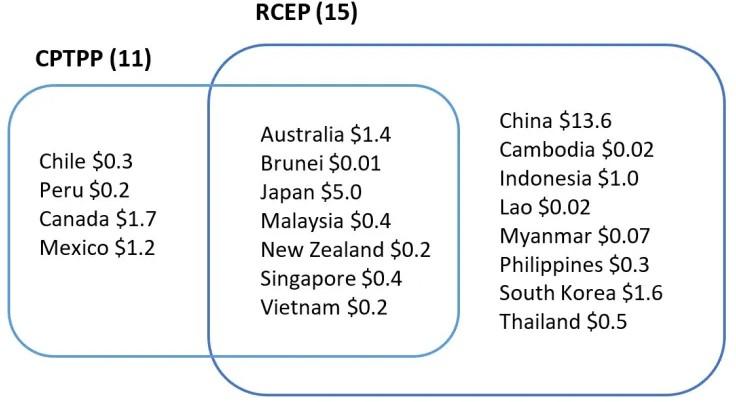
The same forecasts estimate ASEAN to gain US$19 billion annually by 2030.[8] RCEP will be the world’s biggest free trade agreement (FTA) measured in GDP – larger than the CPTPP, the European Union, the South America trade bloc, and the recent United States–Mexico– Canada FTA (see Figure 2).
Figure 2: GDP of Members of RCEP and CPTPP – in trillions of U.S. dollars
Source: authors.
1.1.2. Key Features of the RCEP Agreement
The RCEP is extensive, comprising 20 chapters that cover a wide range of topics not included in previous ASEAN Plus One Free Trade Agreements (ASEAN+1 agreements). For trade in goods, it establishes rules on aspects such as rules of origin, customs procedures, trade facilitation, sanitary and phytosanitary measures, standards, technical regulations, conformity assessment, and trade remedies. Additionally, it includes chapters on trade in services, with specific provisions for sectors such as financial services, telecommunications, and professional services. The agreement further addresses investment, intellectual property, electronic commerce, economic and technological cooperation, support for small and medium-sized enterprises, government procurement, and legal and institutional matters, including dispute resolution.[9]
Notably, the RCEP successfully provides a consolidated rule book for trade in all 15 member states, which the ASEAN+1 agreements could not offer as there were still notable differences in the rules and requirements in each FTA due to separate negotiation processes. This research will further demonstrate the 4 selected major sectors of the RCEP Agreement, including Trade in goods, Trade in service, E-commerce and Investment.
Trade in goods: The RCEP aims to further liberalize trade in goods between the member states by following a number of measures.
- Reduce or eliminate tariffs on goods traded between member states, with a target of 92% reduction over 20 years.
- Prohibit non-tariff barriers such as quotas and licenses, promoting transparency in trade regulations.
- Facilitate trade through measures like simplified customs procedures and faster clearance for qualifying businesses.
- Establish clear rules of origin to determine which goods qualify for preferential treatment within the bloc. This includes allowing materials from different member states to be combined for origin purposes, fostering greater supply chain integration.[10]
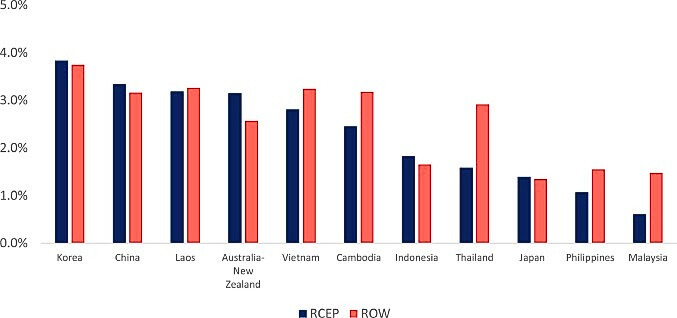
While RCEP doesn’t lead to significant overall tariff reductions due to existing agreements, it consolidates them and simplifies trade procedures, potentially bringing Asia closer to a unified trading region (see figure 3).
Figure 3: Average tariff applied by RCEP countries
Source: Asia and the Global Economy with data from MacMap and UN Comtrade.
Trade in services: The RCEP agreement aims to enhance trade in services by eliminating restrictive and discriminatory barriers to entry. It establishes broad regulations, including market access rules, national treatment, most-favored-nation treatment, and local presence requirements. RCEP employs a “negative list” approach, meaning that member economies are generally open to foreign service providers unless specific sectors are listed as exceptions. However, eight member states—Cambodia, China, Laos, Myanmar, New Zealand, the Philippines, Thailand, and Vietnam—have initially adopted a “positive list” approach, which only permits foreign access to specified sectors. These states are required to transition to the “negative list” approach within six years after the Agreement’s implementation.
E-commerce: The agreement encourages member economies to improve trade administration and processes with electronic means. It requires them to adopt or maintain a legal framework that creates an environment conducive to e-commerce development, including data privacy and consumer protection. RCEP members agreed to maintain the practice of not imposing customs duties for electronic transmissions. RCEP covers commitments on cross-border data flows – the first of its kind for several large and emerging members. These commitments will not apply to financial services and they include exceptions for national security or other public policy reasons.[11]
Investment: The RCEP aims to improve the investment climate in the region by offering greater protection, liberalization, promotion, and facilitation. It guarantees fair treatment to investors from member countries, prohibits performance requirements such as local hiring quotas that go beyond WTO rules, and locks in current investment policies while allowing for future liberalization. Additionally, the agreement focuses on assisting investors even after the investment is made, particularly with resolving any issues or complaints that may arise.
1.1.3. The Macroeconomic Impact of the RCEP Agreement
Economically, the RCEP is significantly larger than the CPTPP. The 15 countries in RCEP make up 29% of global GDP, 25% of world trade, and encompass a population of 2.3 billion, while the 11 CPTPP countries represent 13% of global GDP, 14% of global trade, and a population of 507.7 million.[12] RCEP is expected to boost intraregional trade and reinforce value chains, especially among China, Japan, and South Korea, and between these and other members. In a business-as-usual scenario where the economic impacts of CPTPP and RCEP are added sequentially, the CPTPP is projected to increase global real income by $147 billion by 2030, while RCEP could add an additional $186 billion.[13]
The RCEP trade agreement is expected to benefit member countries by reducing trade costs, making imports cheaper, and boosting the competitiveness of local production. This can lead to increased trade, economic growth, and productivity gains. Countries with lower initial trade barriers and stronger comparative advantage in sectors benefiting from the agreement are likely to see the biggest gains.
It is estimated that RCEP will increase real income in member countries by up to 2.5% by 2035, depending on the specific measures implemented (tariffs, non-tariff measures, rules of origin, and productivity improvements). While there might be a minor negative impact on non-member countries due to trade diversion, this is offset by potential positive effects if RCEP member economies experience significant productivity gains.[14]
1.2. Overview of Provisions Regarding Electronic Commerce in RCEP
The RCEP Agreement is set to significantly reshape e-commerce within the region, with Chapter 12 on Electronic Commerce aimed at facilitating smooth cross-border transactions and driving economic growth. This chapter has three key objectives: (i) to foster e-commerce among RCEP member nations, (ii) to build a trustworthy e-commerce environment, and (iii) to strengthen collaboration among stakeholders to support its development. These goals highlight RCEP’s commitment to expanding digital trade, benefiting businesses and consumers alike.
There are five sections in Chapter 12. Section A regulates General Provisions, Definitions, Principles and Objectives, Scope, and Cooperation. Section B includes Trade Facilitation provisions: Paperless Trading, Electronic Authentication, and Electronic Signature. Section C on Creating a Conducive Environment for Electronic Commerce deals with Customs Duties, Online Consumer Protection, Online Personal Information Protection, Unsolicited Commercial Electronic Messages (spam), Domestic Regulatory Frameworks, Transparency, and Cyber Security. Section D covers the Location of Computer Facilities and Cross-border Transfer of Information by Electronic Means. The final section provides for Dialogue on Electronic Commerce, especially TPP/CPTPP matters omitted from RCEP.
Chapter 12 of the RCEP is comparable to the ASEAN Agreement on Electronic Commerce, which was signed in January 2019 and took effect in December 2021. Under Article 12.3, the scope of this chapter applies to “measures adopted or maintained by a Party that affect electronic commerce”. Particularly, “measures” are broadly defined in the agreement to include any legislation, regulation, rule, procedure, decision, administrative action, or other type of government action. The term “affect” refers to a broad range of initiatives, not just those aimed directly at e-commerce. Although the term “electronic commerce” is not defined, the chapter’s prohibitions include considerably more than cross-border online business transactions, including personal privacy and spam. Moreover, Chapter 12 is specifically excluded from the dispute resolution mechanism mentioned in Article 12.17.3: “No Party shall have recourse to dispute settlement under Chapter 19 (Dispute Settlement) for any matter arising under this Chapter”. Accordingly, disagreements over the interpretation and application of e-commerce provisions should be resolved initially through mutual consultation and by the RCEP Joint Committee in case the consultation fails. Thus, the e-commerce chapter’s commitments are essentially non-binding and not enforceable.
For further analysis, the key provisions of e-commerce cover the following points:
- Acknowledgement of the validity of electronic signatures, unless otherwise regulated (Article 12.6).
- Enactment of legal frameworks on the protection of personal data and protection of e‑commerce users from fraud and misleading practices (Article 12.16).
- Maintaining the current practice of not imposing customs duties on electronic transmissions between member states (Article 12.11).
- Prohibiting the requirement to use or locate a computing facility in a certain territory to conduct business in that territory (Article 12.14).
- Prohibiting the prevention of cross-border transfer of information unless otherwise provided to achieve public policy objectives and protect security interests (Article 12.15).[15]
2. Impact of Electronic Commerce Provisions in the RCEP Agreement on the Global Economy
2.1. Impact on the Economies of RCEP Member Countries
RCEP covers trade in traditional commodities which are transacted with the assistance of digital technologies. Chapter 12 has two provisions designed to facilitate that kind of trade, covering three kinds of measures: paperless trading, electronic signatures, and electronic authentication.
The first two measures, paperless trading and electronic signatures, reflect the RCEP preference for flexibility and good faith commitments over enforceable obligations and seek to balance assistance to exporters and importers with the burdens of compliance on businesses and governments. Specifically, under Article 12.5 RCEP, the general obligation on paperless trading is mandatory (“shall”). However, it only requires parties to “work towards” implementing paperless trading initiatives and to “endeavour” to accept trade administration documents as the legal equivalent of paper versions and make trade administration documents available to the public in electronic form. Additionally, regarding e-signatures under Article 12.6 RCEP, full implementation of obligations on it would make transactions easier for ASEAN businesses to operate across the border, and potentially within the domestic economy. The last measure is e‑authentication, with its provision also under Article 12.6 potentially benefiting all businesses by providing assurance of identity in sensitive transactions and minimizing risks of fraud. This provision also provides some flexibility for governments to impose performance standards or certification requirements on a particular category of e transactions.
In recent years, e-commerce provisions under the RCEP have the potential to generate significant impacts on the countries involved. In 2020, RCEP had approximately 2.2 billion people who engaged in online purchases of consumer goods, with a combined size of 26.2 trillion USD or 30 percent of the world’s GDP.[16] Furthermore, within the RCEP member countries, the average annual consumer spending on consumer goods reached US$1,022 in 2020, surpassing the global average of US$703 by a significant margin.[17] The e-commerce market for consumer goods within the RCEP experienced remarkable growth, with a substantial increase of 28.5% from US$1.1 trillion in 2019 to US$1.4 trillion in 2020.[18] Notably, China has emerged as the dominant player in the RCEP’s consumer e-commerce market, with the highest number of people purchasing consumer goods via the Internet (926.1 million). It is projected that China will continue to maintain its position as the largest market for consumer goods e-commerce among the RCEP member nations. Furthermore, South Korea recorded the highest average annual consumer spending on consumer goods e-commerce, with an amount of US$2,012. Australia followed closely with US$1,492, while China, New Zealand, and Japan had average annual consumer spending figures of US$1,206, US$1,102, and US$1,078, respectively.
Figure 4: E-commerce Consumer Spending in RCEP Countries
RCEP members[19] | Numbers of people purchasing consumer goods via the Internet | Average annual consumer spending on consumer goods e‑commerce purchases |
China | 926.1 million | 1,206 |
Indonesia | 138.1 million | 219 |
Japan | 97.1 million | 1,078 |
Vietnam | 45.6 million | 132 |
Philippines | 38.9 million | 91 |
South Korea | 36.9 million | 2.012 |
Thailand | 33.7 million | 216 |
Australia | 18.3 million | 1,492 |
Malaysia | 13.1 million | 341 |
New Zealand | 3.1 million | 1,102 |
Singapore | 3.1 million | 785 |
Sources: Data Reportal and SERC.
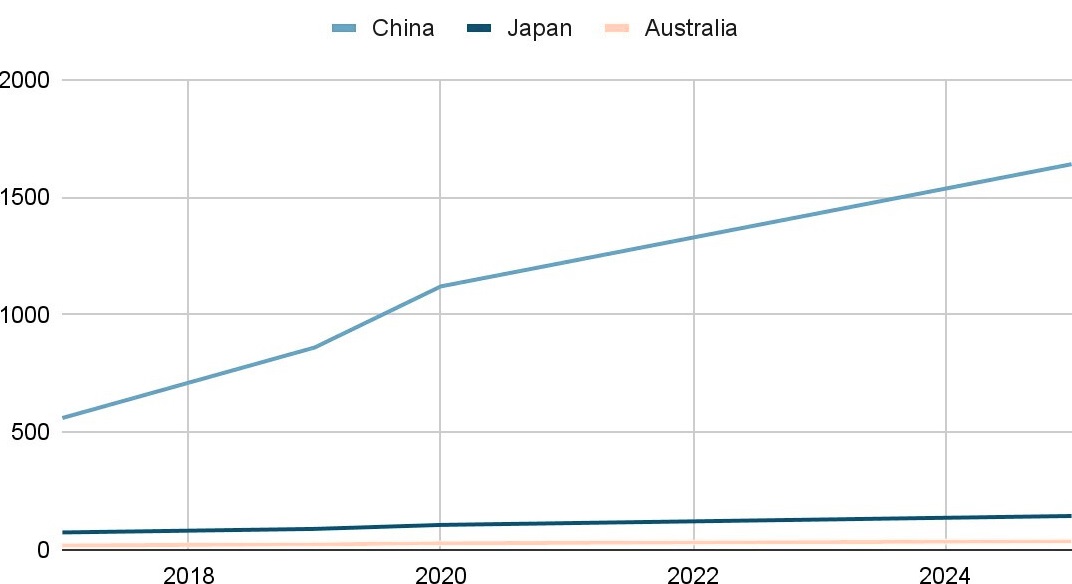
The data below also show that e-commerce is expected to grow among RCEP countries.
Figure 5: The Potential of E-commerce Value and Growth in China, Japan and Australia
Source: Statista, Google, TEMASEK, Bain & Company, and Global Data.
The provided chart illustrates the potential of e-commerce value and growth in China, Japan, and Australia from 2018 to 2024. China, a key RCEP member, demonstrates the most substantial expansion, with its e-commerce value tripling from $500 billion in 2018 to $1,500 billion in 2024. Japan and Australia also exhibit promising growth rates.
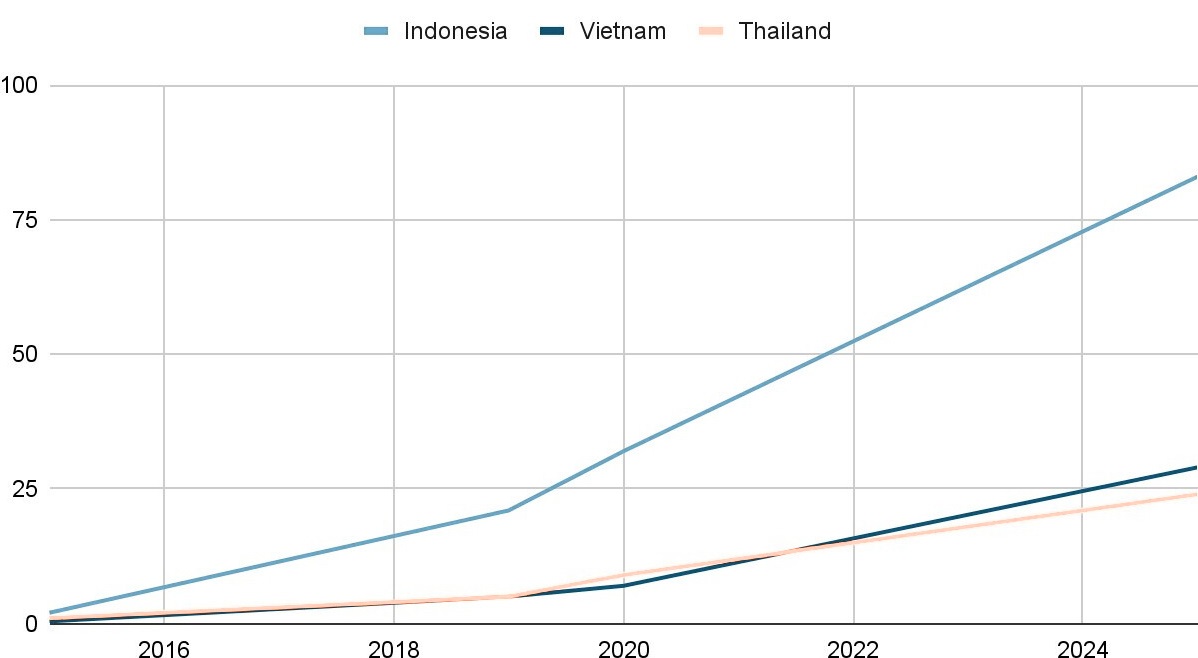
Figure 6: The Potential of E-commerce Value and Growth in Indonesia,
Vietnam, Thailand
Source: Statista, Google, TEMASEK, Bain & Company, and Global Data.
This given chart shows the potential of e-commerce value and growth in Indonesia, Vietnam, and Thailand from 2016 to 2024. It can be observed that Indonesia dominates e-commerce among the 3 countries, with its value surging from approximately $10 billion in 2016 to nearly $75 billion in 2024, a staggering 650% growth. While Vietnam and Thailand’s growth rates are lower at 500% and 200%, respectively, they still exhibit substantial expansion.
Besides, the ASEAN-6 countries,[20] although currently falling below the RCEP’s benchmark average annual spending of US$1,022, present significant untapped market potential due to their increasing economic growth, higher income levels, and consumerism. This indicates that the implementation of e-commerce provisions within the RCEP framework has the potential to create fresh opportunities for businesses in these countries to expand their e-commerce presence and tap into a burgeoning market.[21] Moreover, more than half of the internet users in several RCEP member countries have already embraced mobile commerce (“m-commerce”) by making online purchases through their mobile devices. For instance, Indonesia leads the way with 79.1% of internet users engaging in m-commerce, followed by Thailand (74.2%), the Philippines (69.6%), Malaysia (68.4%), China (64.3%), Vietnam (61.4%), South Korea (59.9%), and Singapore (56.9%).[22] These figures highlight a robust trend towards m-commerce in these nations, indicating that the e-commerce provisions under the RCEP have the potential to further fuel this growth.
Regarding e-commerce payment, RCEP’s e-commerce provisions have the potential to exert a significant influence on consumers’ preferred payment methods. For instance, in China, e-wallets accounted for 72% of e-commerce payments, demonstrating the highest adoption rate among RCEP member countries. Singapore, Japan, and South Korea also exhibited a substantial percentage (45%-58%) of e-commerce payments made through credit cards. In Indonesia, Malaysia, Thailand, and Vietnam, a notable portion (23%-31%) of customers have embraced bank transfers as their preferred e-commerce payment method.[23]
Besides, the impact of RCEP’s e-commerce provisions extends to consumer behavior, particularly in terms of online product research. Statistics reveal that the Philippines has the highest percentage of internet users, with 74.1%, engaging in online product research before making a purchase within the RCEP countries. This is closely followed by Indonesia (73.9%), Malaysia (68.2%), South Korea (64.9%), and New Zealand (63.5%). Moreover, in Singapore, Thailand, Australia, and Vietnam, more than half of internet users (from 56.5% to 59.8%) also conduct online product research. In Japan and China, the percentages are slightly lower, at 55.1% and 42.8%, respectively.[24]
2.2. Impact on the General Global Economy
RCEP establishes a framework for digital trade that tackles key issues such as cybersecurity and consumer and privacy protections in e-commerce. These measures have made international enterprises more willing to engage in trade, highlighting e-commerce’s role in advancing globalization. RCEP’s chapter on the digital economy includes multilateral guidelines, commitments to liberalize e-commerce, a moratorium on customs duties for electronic transmissions, and rules on data localization. Similar to provisions in the CPTPP, RCEP commits members to safeguard personal data and uphold the moratorium on e-transmission duties. While this framework is a promising foundation, increased cooperation is essential to fully realize the potential of the digital economy.
Protecting consumers’ legitimate rights in cross-border e-commerce is essential for fostering a reliable e-commerce environment. While cross-border e-commerce enhances convenience and provides high-quality experiences, it also presents challenges such as unauthorized personal data disclosure and buyer harassment. To address these, RCEP includes provisions focused on safeguarding online consumer rights. These include stringent regulations with substantial penalties for illegal activities, mechanisms for protecting overseas consumer rights, and rules on online data security. Additionally, RCEP encourages partners to publicly share their methods for consumer information protection and detail the steps in their security processes. These initiatives emphasize the importance of consumer protection, aiming to build a healthy cross-border e-commerce ecosystem. The measures enhance consumer trust and satisfaction, driving the sector’s overall growth.[25] The RCEP also plays a pivotal role in developing rules to address both emerging economic opportunities and security challenges presented by new technologies, such as 5G telecommunications and digital trade. While multilateral rules under the WTO may sufficiently cover trade in goods, they fall short for a significant portion of 21st-century international commerce, which increasingly encompasses services, investment, data flows, and novel technologies. The existing patchwork of rules from smaller agreements leaves substantial gaps and contributes to economic fragmentation, underscoring the importance of RCEP’s contributions to harmonizing standards and fostering greater economic integration across the region.
Practically, RCEP’s e-commerce contributes greatly to the world’s economy, which can be seen through the total amount spent in RCEP’s consumer e-commerce in 2020 regarding food and personal care at US$375 billion, occupying a 66.5% share of the world, followed by toys, DIY and hobbies (61.8%), fashion and beauty (52.9%), furniture and appliances (51.9%), electronic physical media (51.2%) and video games (51.2%).[26]
RCEP provisions on e-commerce and the digital economy are similar to those included in the CPTPP, with stronger carve-outs for national security and public policy measures that may stifle the free flow of data and information. Despite being narrower in coverage than agreements such as the Australia–Singapore Digital Economy Agreement, RCEP provisions reflect the extent to which the RCEP agreement represents the current consensus among countries of varying sizes and levels of development.[27] Given that most RCEP economies, excluding Cambodia, Indonesia, the Philippines, and Vietnam, are part of the WTO Joint Statement Initiative, RCEP demonstrates how any future multilateral agreement on e-commerce could be framed.[28] Additionally, as RCEP also has a role to play in updating the global rules for the digital economy, ensuring that subsequent agreements pursue an open regionalism approach will guarantee that this global perspective is reflected in the future governance regime for the digital economy in Asia and the Pacific.[29]
3. Challenges in Implementing RCEP’s E-Commerce Provisions
3.1. Differences among RCEP Members
3.1.1. Different Regulations and Platforms
One of the main obstacles in the RCEP framework is the regulatory differences among the member countries. The agreement includes nations with diverse e-commerce regulations and standards, creating challenges in harmonizing these rules. The varying stages of economic development, sizes of e-commerce markets, and differing views on desirable e-commerce rules, customs, and trade regulations complicate cross-border e-commerce activities. For example, one country may enforce strict data privacy laws, while another may have more relaxed regulations, making it difficult for businesses to operate seamlessly across multiple jurisdictions. This disparity forces businesses to navigate a complex web of regulations.
Additionally, the absence of a unified cross-border e-commerce platform within the RCEP member states exacerbates these challenges. Establishing a unified platform that streamlines transactions and resolves regulatory and logistical obstacles would simplify cross-border e-commerce operations. Without such a platform, businesses are forced to contend with multiple platforms and systems, introducing unnecessary complexity into their operations and potentially limiting the growth of cross-border e-commerce ventures within the region.
3.1.2. Different Cultures
The cultural diversity of RCEP members poses a significant challenge for enterprises in integrating historical backgrounds, religious beliefs, traditional cultures, consumer preferences, and business habits while designing and operating cross-border e-commerce platforms. This cultural heterogeneity makes it difficult to create a unified regional e-commerce platform. As a result, there is a prevalence of numerous local e-commerce platforms within each country, but fewer regional platforms that cater to the entire Southeast Asian market. This fragmentation hampers the seamless integration of cross-border e-commerce activities and limits the potential for businesses to tap into the broader regional market. For instance, consumer preferences and purchasing behaviors may vary significantly between countries due to cultural differences, which necessitates businesses tailoring their strategies and offerings accordingly. Effective localization strategies are essential for businesses to reach a wider audience.
The use of different national languages on e-commerce platforms across member countries is one of the difficulties. While English is considered an international language, each RCEP country has its national language, resulting in diverse language requirements on e-commerce platforms. This language barrier can pose obstacles for businesses engaging in cross-border e-commerce, as a significant percentage of global consumers (65% according to the “Can’t Read, Won’t Buy” survey) prefer to purchase exclusively in their native language. Furthermore, customer service plays a crucial role in driving customer satisfaction and repeat purchases. A Zendesk survey revealed that 62% of B2B and 42% of B2C customers are more likely to make additional purchases after experiencing good customer service. Therefore, addressing language challenges in e‑commerce provision under RCEP is essential to enhance customer experience and foster e‑commerce.
3.1.3. Different Payment Methods
Another challenge is the discrepancy in digital payment systems across RCEP member countries. E-commerce heavily relies on digital payments, but the availability and acceptance of digital payment methods can differ significantly. This discrepancy is evident in the adoption rates of different payment methods. For example, China has the highest adoption rate of e-wallets, with 72% of e-commerce payments made through this method. Meanwhile, Singapore, Japan, and South Korea have a high percentage (45%-58%) of e-commerce payments made via credit cards. In Indonesia, Malaysia, Thailand, and Vietnam, a significant portion (23%-31%) of customers prefer e-commerce payments through bank transfers. Additionally, cash on delivery (COD) is a common payment method in the Philippines, Thailand, and Vietnam, accounting for a considerable share (22%-28%) of e-commerce payments.[30] Fragmented payment systems and a lack of interoperability can make it difficult for consumers to pay for online purchases across borders. These disparities in payment methods pose challenges for businesses and consumers engaging in cross-border e-commerce transactions within the RCEP region. The lack of interoperability and varying security standards across payment systems can hinder seamless cross-border transactions and create barriers to the growth of e-commerce in the region.
3.2 Difficulties in Transportation, Infrastructure, Lack of Knowledge and Skills
In cross-border e-commerce, transportation plays a crucial role, but it is often fraught with challenges. The complex logistics of multiple transportation links can lead to frequent issues such as customs clearance delays, blocked shipments, and complications arising from force majeure events. These factors can contribute to slow delivery times, frustrating both businesses and consumers. Consumers on major e-commerce platforms are increasingly unwilling to accept shipments that take more than 3-4 days to arrive.[31] This demand for faster delivery highlights the urgency of improving cross-border transportation processes and customs procedures within the RCEP region to meet consumer expectations and support the growth of international e-commerce.
Figure 7: Comparative Analysis of Export and Import Compliance Times of RCEP Countries
| Australia | China | Japan | Malaysia | New Zealand | Singapore | |
| Time to export, in terms of | Hours | Hours | Hours | Hours | Hours | Hours |
| Border Compliance | 36 | 21 | 27 | 28 | 37 | 10 |
| Documentary compliance | 7 | 9 | 2 | 10 | 3 | 2 |
| Time to import, in terms of | Hours | Hours | Hours | Hours | Hours | Hours |
| Border compliance | 39 | 36 | 40 | 36 | 25 | 33 |
| Documentary compliance | 4 | 13 | 3 | 7 | 1 | 3 |
Source: Doing business 2020.
The data above comparing export and import times across RCEP countries sheds light on potential challenges in cross-border e-commerce transportation. The differences in border compliance times, ranging from 10 hours in Singapore to 36 hours in Australia, indicate that the customs clearance process can be a source of delays and complications in cross-border transportation. Besides, the data shows that the time required for border compliance and documentary compliance varies significantly across the RCEP countries. This suggests that the cross-border transportation process can be complex and time-consuming, as it involves navigating different customs and regulatory requirements in each country.
Furthermore, in Malaysia, according to Tam Yong Sheng, eBay Southeast Asia’s Head of Cross‑Border Trade Business Development, Malaysian small and medium enterprises (SME) face difficulties due to their unfamiliarity with export shipping documentation and difficulties in obtaining competitive shipping rates for global e-commerce. Despite Malaysia being recognized as a manufacturing hub for automotive and furniture products on eBay’s platform, the lack of knowledge and experience in export shipping processes hampers SMEs’ ability to effectively engage in cross-border trade.
Additionally, Southeast Asia countries’ logistic infrastructure is inadequate, including poor road networks, inadequate ports, and limited air transportation.[32] Also, infrastructures of these countries vary significantly. This can be a challenge for cross-border e-commerce operations under RCEP.[33] As trade volumes increase, more logistics infrastructure may be needed to support the movement of goods.[34] Differences in transportation networks, customs procedures, and warehouse facilities can lead to delays, inefficiencies, and increased costs for businesses involved in cross-border trade. For example, a company may face difficulties in shipping products from one country to another due to inadequate transportation infrastructure or complex customs clearance processes.
Figure 8: Logistics Infrastructure of Countries in ASEAN
| Port | Airport | Railway | Road | |
Cambodia | Poor | Fair | Poor | Poor |
Indonesia | Poor | Fair | Good | Fair |
Laos | Not applicable | Poor | Not applicable | Fair |
Malaysia | Good | Good | Good | Good |
Philippines | Fair | Fair | Poor | Fair |
Singapore | Good | Good | Good | Good |
Thailand | Good | Good | Good | Good |
Vietnam | Fair | Fair | Fair | Fair |
Source: CIA The World Fact Book.
The data above shows that the quality of transportation infrastructure differs greatly among the Southeast Asian countries. While countries such as Malaysia, Singapore appear to have a good transportation network overall, countries like Cambodia and Laos seem to have more limited and poorer infrastructure. These disparities can lead to imbalances and inefficiencies in the movement of goods across borders.
The lack of digital infrastructure in certain developing countries poses a significant challenge for e-commerce provision under the RCEP agreement.[35] Access to reliable and affordable internet infrastructure, as well as digital literacy, varies greatly among RCEP member countries. This discrepancy creates an uneven playing field for e-commerce businesses, with those in developed economies enjoying a clear advantage. Inadequate internet connectivity and limited access to digital technologies hinder the growth and adoption of e-commerce in some countries, limiting their participation in cross-border trade. For instance, businesses in developed economies may have access to high-speed internet, reliable online payment systems, and advanced logistics infrastructure, enabling them to operate smoothly in the e-commerce space. In contrast, businesses in developing economies may face challenges due to slow internet speeds, limited online payment options, and inadequate logistics networks. This disparity not only affects the competitiveness of businesses in developing countries but also limits their ability to fully leverage the benefits of cross-border e-commerce.
The implementation of the e-signatures provision also requires technology and relevant platforms, which could be challenging for smaller businesses and those from countries with limited technology and connectivity. Moreover, governments may face substantial implementation costs to achieve full compliance.
The growth of e-commerce can be hindered by unreliable and slow internet connections, as they negatively impact business productivity by slowing down response times and communication with customers and suppliers.[36]
Figure 9: Internet Speed by RCEP Countries
RCEP countries | Mobile (Mbps) | Fixed broadband (Mbps) |
South Korea | 192.6 | 217.2 |
China | 153.1 | 178.6 |
Australia | 125.7 | 80.0 |
Singapore | 82.2 | 250.4 |
NewZealand | 82.1 | 164.2 |
Japan | 59.7 | 177.4 |
Global average | 54.5 | 105.2 |
Brunei | 52.0 | 36.1 |
Thailand | 50.3 | 214.3 |
Vietnam | 44.5 | 70.1 |
Philippines | 32.0 | 58.7 |
Laos | 30.3 | 43.0 |
Cambodia | 24.7 | 24.4 |
Myanmar | 22.2 | 22.7 |
Indonesia | 21.0 | 26.1 |
Source: Global speed index as of May 2021.
The table above shows that while the global average internet speed is 105.2 Mbps, several countries like Myanmar, Cambodia, Malaysia, and Laos have much lower internet speeds, ranging from around 22 Mbps to 102 Mbps. This can create challenges for businesses, especially those engaged in e-commerce operations that rely on fast and reliable internet.
The implementation of the e-signatures provision, therefore, may face difficulties when it requires technology and relevant platforms, especially for smaller businesses and those from countries with limited technology and connectivity.[37]
Another significant challenge is the lack of understanding and skills related to e-commerce among businesses, particularly small and medium-sized enterprises (SMEs).[38] Research conducted by ACCCIM M-BECS[39] for 2H2018 and 1H2019F highlighted that the lack of IT knowledge or IT technicians has been a barrier for SMEs in adopting e-commerce. This lack of understanding hampers their ability to leverage the potential of e-commerce platforms and technologies. Additionally, the absence of digital marketing resources and e-commerce skills further inhibits local businesses from effectively connecting with potential customers and identifying market segments. A study by Workday in 2020 revealed that 67% of Malaysian businesses indicated that less than half of their employees possess digital skills and capabilities, and 13% of respondents stated that almost none of their employees have digital experience or skills. This shortage of digital expertise within organizations limits their capacity to navigate the complexities of e-commerce, implement effective digital marketing strategies, and adapt to the changing landscape of online business.
3.3. Challenges of Intellectual Property Rights (IPR) Protection and Sales of Unqualified Products
E-commerce provisions under RCEP face challenges related to intellectual property protection, online consumer information protection, and the sale of unqualified products. Intellectual property protection is crucial in the digital economy, as it involves safeguarding copyrights, trademarks, patents, and trade secrets. However, enforcing intellectual property rights in the online environment can be challenging due to the borderless nature of e-commerce and the ease of digital piracy. Sellers could potentially employ a different company’s trademark to promote their products or sell merchandise using the name of a famous trademark without obtaining consent.
Additionally, the sale of unqualified products poses risks to consumers and undermines fair competition. Counterfeit goods and substandard products can proliferate in the e-commerce space, requiring effective mechanisms for product quality control, certification, and enforcement. Addressing these challenges within the e-commerce provisions of RCEP necessitates robust frameworks for intellectual property rights enforcement, data protection regulations, and mechanisms to combat the sale of unqualified products, promoting trust and confidence in cross-border e-commerce transactions.
3.4. Difficulties concerning tax management
The e-commerce provisions under RCEP present significant challenges in effectively taxing the digital economy. These challenges include the extra-territorial operation of digital multinational enterprises (MNEs), sophisticated tax planning strategies that facilitate profit shifting through related party arrangements, and the opacity of business models that rely on mining data obtained from sources for free. The extra-territorial nature of digital MNEs makes it difficult for governments to assert tax jurisdiction and capture their fair share of tax revenue. These companies often employ complex tax planning techniques, such as engaging in transactions with related parties like arms-length contractors, royalties, and management fees, which can lead to profit shifting and erosion of taxable income. Moreover, the opaqueness of business models that rely on data mining obtained from sources for free can complicate tax assessment and enforcement efforts. Additionally, specific e-commerce provisions within RCEP, particularly those that prevent requirements for a local presence and data localization, may further hinder a government’s ability to effectively tax the digital economy. These challenges underscore the need for robust international cooperation and coordination to develop effective tax frameworks that address the unique characteristics and complexities of the digital economy.
4. Recommendations to Promote the Effectiveness of e-Commerce Provisions of RCEP
First, to address the challenges posed by regulatory differences within the member countries of the RCEP, efforts should be made to harmonize e-commerce regulations and standards among RCEP member countries. This involves facilitating dialogue and cooperation to establish common frameworks that promote consistency and interoperability in cross-border e-commerce activities. Regular consultations and negotiations can help align regulatory approaches and minimize discrepancies. Establishing mechanisms for sharing information and best practices among member countries can facilitate understanding and learning from each other’s experiences, promoting convergence towards commonly accepted e-commerce rules and practices.
Second, it is crucial to establish a unified platform for the RCEP cross-border e-commerce market. This platform would serve as a centralized hub for businesses and consumers to engage in cross-border trade seamlessly. The platform should prioritize features such as language localization, secure payment systems, standardized product listings, and integrated logistics services. By providing a unified platform, businesses from RCEP countries can easily access a larger consumer base, while consumers can enjoy a wider range of products and services. For example, the platform could offer language options for different countries within the region, making it easier for businesses and consumers to communicate and conduct transactions. Additionally, integrating secure payment systems and logistics services into the platform would streamline the entire cross-border e-commerce process, ensuring efficient and reliable transactions. Furthermore, the platform should adhere to standardized product listings to enhance transparency and build trust among businesses and consumers. Such a platform needs to promote the circulation of Central Bank Digital Currency (CBDC) within the RCEP region.[40] By leveraging the secure and efficient nature of digital currencies, coupled with blockchain distributed technology, cross-border e-commerce can expand the utilization of digital currencies. Integrating the payment systems of cross-border e‑commerce platforms with the payment systems of other countries can be taken into consideration.
Third, countries should fully utilize technologies such as cloud computing, big data, and the Internet of Things to encourage the integration of cross-border e-commerce with new technologies. RCEP countries also need to prioritize the construction and promotion of robust e-commerce infrastructure. This includes investing in broadband internet connectivity, developing reliable logistics networks, and ensuring secure online payment systems. By improving the informatization level and e-commerce operation capability, RCEP countries can enhance their core competitiveness in cross-border e-commerce. For example, upgrading internet infrastructure, expanding high-speed internet access in remote areas, and establishing efficient logistics networks can facilitate smoother and faster cross-border transactions.
Fourth, efficient customs clearance procedures for exports and imports are crucial to facilitate seamless e-commerce transactions. Governments should prioritize reliable customs clearance for goods shipped through selected e-commerce platforms in RCEP countries, ensuring on-schedule, hassle-free processing with reduced charges and simplified procedures. Streamlining customs clearance can significantly enhance the efficiency and competitiveness of cross-border e‑commerce.
RCEP countries should prioritize capacity-building efforts to enhance e-commerce operation capabilities. This involves providing training and support to businesses, especially SMEs, in areas such as digital marketing, e-commerce platform management, and online payment systems. By equipping businesses with the necessary skills and knowledge, RCEP countries can empower SMEs to participate more effectively in cross-border e-commerce. For example, organizing training programs, workshops, and mentoring initiatives can help SMEs adapt to the digital landscape and seize opportunities in cross-border markets. Moreover, collaboration and knowledge-sharing among RCEP countries can significantly enhance the effectiveness of e‑commerce provisions. By fostering cooperation in areas such as technology standards, best practices, and cross-border data flows, RCEP countries can create a supportive ecosystem for cross-border e-commerce. For instance, establishing platforms for information exchange, joint research projects, and policy dialogues can facilitate the sharing of experiences and lessons learned, leading to more efficient and effective e-commerce practices.
Regarding IP issues, IPR protection should also be paid attention to. Enterprises should conduct thorough investigations into IP issues in their target markets, gaining a comprehensive understanding of local IP policies. They should also take reasonable preventive measures to address potential IP problems. Before engaging in foreign trade, enterprises should conduct detailed searches for trademarks, patents, and other relevant trade goods to avoid infringement issues. It is advisable to apply for patents and trademarks in advance to establish a competitive advantage in terms of intellectual property rights and reap the benefits of IP ownership. Additionally, enterprises should prioritize the preservation and protection of data related to intellectual property rights throughout the transaction process. They should remain vigilant about local policies, consider hiring local experts for training and knowledge exchange, and elevate the importance of intellectual property rights within their cross-border e-commerce operations. By adopting these measures, enterprises can safeguard their IP assets, mitigate the risk of infringement, and position themselves for sustained success in the competitive cross-border e‑commerce landscape.
Relevant laws and regulations governing the development and operation of internet technologies in cross-border e-commerce need to be developed. This includes establishing legal frameworks for data protection, consumer rights, and intellectual property rights. Clear and standardized regulations can provide a stable and predictable environment for businesses, foster trust among consumers, and encourage cross-border trade. For instance, enacting laws that protect personal data and regulate online transactions can enhance consumer confidence in cross-border e‑commerce.
Besides, establishing robust mechanisms for product quality control and certification is crucial. This can include implementing stringent standards, conducting inspections, and certification processes to ensure that products sold in cross-border e-commerce meet the required quality and safety standards. Collaboration between law enforcement agencies, customs authorities, and e‑commerce platforms can help identify and take action against sellers involved in the sale of counterfeit products. Promoting consumer awareness campaigns, providing information about authorized sellers and genuine products, and encouraging consumers to report suspicious activities can help mitigate the risks and empower consumers to make informed purchasing decisions.
Furthermore, given the extra-territorial nature of digital MNEs, international cooperation and coordination among RCEP member countries are crucial. Governments should collaborate to develop common tax frameworks and share information to effectively tax digital transactions and capture their fair share of tax revenue. Governments should review and update their tax rules and regulations to address the complexities of the digital economy. This may involve introducing specific provisions that target digital activities, such as digital service taxes or equalization levies, to ensure that digital MNEs are subject to a fair and reasonable level of taxation. Governments can also consider revising transfer pricing rules to prevent profit shifting through related party transactions and ensure that taxable income is not artificially reduced.
There is also a need to encourage digital MNEs to be more transparent in their tax reporting. Requiring these companies to disclose key financial and tax-related information, including revenues, profits, and taxes paid in each jurisdiction, can provide governments with the necessary data to assess and enforce tax obligations effectively. Enhanced transparency can be achieved through international reporting standards and the exchange of information agreements among RCEP member countries.
Governments should invest in building robust digital tax administration capabilities to keep pace with the rapidly evolving digital economy. This includes developing advanced data analytics tools and technologies to identify tax risks, detect profit-shifting patterns, and enforce tax compliance effectively. Governments can also explore the use of blockchain or other innovative technologies to enhance transparency and traceability in digital transactions.
To promote the effectiveness of e-commerce within RCEP countries, it is necessary to encourage research and development by promoting the development of unique or high-quality products that can command premium prices in the market, enhancing brand awareness for businesses. With the increasing adoption of e-commerce, it becomes essential for companies to differentiate their products’ brand from competitors. Research shows that a significant percentage of RCEP consumers conduct online product research before making a purchase.[41] Therefore, having accurate and useful information available online about a company’s background, product specifications, and customer feedback can strongly influence a buyer’s decision. One recommendation is for businesses, particularly SMEs, to invest in digital advertising, including a well-designed and informative website. This allows companies to showcase their brand, provide detailed product information, and engage with customers. Businesses should actively utilize digital marketing strategies to increase their brand visibility and reach a broader audience. This can include search engine optimization techniques, social media marketing, influencer collaborations, targeted online advertising, etc.
By implementing these recommendations effectively, the effectiveness of RCEP’s implementation can be enhanced, thereby promoting the global economy.
Conclusion
The RCEP holds immense potential to transform the e-commerce landscape within its member countries. Its dedicated chapter on e-commerce, crafted to streamline cross-border transactions, presents an opportunity for economic growth and empowerment for businesses and consumers alike.
RCEP’s e-commerce provisions offer several advantages. They promote paperless trading, facilitate the use of electronic signatures and authentication, and establish a legal framework for electronic transactions. These measures aim to simplify trade processes, enhance security, and foster consumer trust. Additionally, RCEP’s commitment to not imposing customs duties on electronic transmissions encourages the growth of the digital economy.
The impact of RCEP’s e-commerce provisions extends beyond the member states. It contributes to the global economy by boosting international trade, fostering innovation, and promoting consumer welfare. RCEP sets a precedent for future multilateral agreements on e-commerce, paving the way for a more inclusive and prosperous digital future.
However, implementing RCEP’s e-commerce provisions effectively comes with its own set of challenges. The diverse regulatory environments, varying levels of digital infrastructure development, and cultural differences among member countries pose significant hurdles. These challenges necessitate a collaborative effort from governments, businesses, and other stakeholders.
Governments can play a crucial role in harmonizing regulations, establishing a unified e-commerce platform, and investing in infrastructure development. Businesses need to adapt their strategies to cater to the diverse cultural landscape within the RCEP region, while also prioritizing data security and consumer protection. Finally, fostering regional cooperation and knowledge sharing among stakeholders is essential for overcoming these challenges and maximizing the potential benefits of RCEP’s e-commerce provisions.
In conclusion, while RCEP’s e-commerce provisions present a significant step forward in facilitating cross-border trade and promoting digital integration, their successful implementation requires a multi-pronged approach that addresses the existing challenges. By working together, RCEP member countries can unlock the full potential of this agreement and contribute to a more prosperous and inclusive digital future for the region and beyond.
Bibliography
Institutional Documentation
Eduardo Pedrosa & Christopher Findlay, “State of the Region Report 2020” (2020) Pacific Economic Cooperation Council, online: <l1nq.com/2hdLT>.
Jong Woo Kang et al, “Regional Comprehensive Economic Partnership: Overview and Economic Impact” (2020) 164 Asian Development Banks Briefs 1, online: <tinyurl.com/yc82fmm4>.
Chapters
Linwei Ye & Fei Wang, “Research on the Impact of Digital Currency on Cross-Border E-Commerce Under RCEP: Based on Entropy Method and Regression Model” (2023) in Nebojša Radojević, Gang Xu & Datuk Dr Hj Kasim Hj Md Mansurat, Proceedings of the 2022 International Conference on Artificial Intelligence, Internet and Digital Economy (ICAID 2022), Paris, Atlantis Press at 171, online: <doi.org/10.2991/978-94-6463-010-7_19>.
Mahani Hamdan, Mohammad Anshari & Norainie Ahmad, “An Overview of Regional Comprehensive Economic Partnership (RCEP)” in Regional Comprehensive Economic Partnership (Charjah: Bentham Science Publishers, 2023) at 2, online: < doi.org/10.2174/9789815123227123010004>.
Articles
Li Cong, Cong Kun & Cuimeng Ran, “Research on the Path and Policy of RCEP Promoting the High-quality Development of China’s Cross-border E-commerce” (2022) 2:5 Frontiers in Sustainable Development 47.
Cai, Li, Cheng Jie & Wen-Xia Wang, “The Impact of Trade Facilitation on China’s Cross-Border E-Commerce Exports: A Focus on the Trade Facilitation Index in RCEP Member Countries” (2022) 26:7 Journal of Korea Trade 109.
Carmen Estrades et al, “Estimating the Economic Impacts of the Regional Comprehensive Economic Partnership” (2023) 3:2 Asia and the Global Economy 100060, online: <doi.org/10.1016/j.aglobe.2023.100060>.
Inkyo Cheong & Jose Tongzon, “Comparing the Economic Impact of the Trans-Pacific Partnership and the Regional Comprehensive Economic Partnership”, (2013) 12:2 Asian Economic Papers 144, online: <dx.doi.org/10.1162/ASEP_a_00218>.
Ji Meiyu, Xinxiang Gao & Yichang Liang, “Opportunities and Challenges of Cross-Border E-Commerce Development Cooperation between China and Southeast Asian Countries—Based on the Perspective of the Entry into Force of RCEP” (2023) 5:13 Academic Journal of Business & Management 136, online: </doi.org/10.25236/AJBM.2023.051319>.
Research Papers
Cheah, Wen Chong et al, “Accelerating Growth: How RCEP Facilitates ASEAN Trade in the Digital Era” (2020) #03-2020 Asia Competitiveness Institute Research Paper Series 2.
Martin Luther Munu, “E-Commerce Provisions in the Regional Comprehensive Economic Partnership: A Milestone for a Global Rule?” (2023) 8 World Trade Institute, Working Paper, online: <tinyurl.com/4bnkjas4>.
Peter A. Petri & Michael Plummer, “East Asia Decouples from the United States: Trade War, COVID-19, and East Asia’s New Trade Blocs” (2020) PIIE, Working Paper, online: <tinyurl.com/4dve76aa>.
“Regional Comprehensive Economic Partnership (RCEP): E-commerce & SMEs” (2021) Socio‑Economic Research Centre.
Shiro Amstrong, Rebeca Sta Maria & Tetsuya Watanabe, “Towards an Asia-Pacific Digital Economy Governance Regime” (2021) Research Institute of Economy, Trade and Industry.
Online Sources
“Changing Dynamics of Logistics in Southeast Asia” (2023) PortCalls, online: <tinyurl.com/26rybh6t>.
“GDP and population of RCEP member countries” (2020), Vietnam plus, online: <tinyurl.com/4y85pavj>.
Grace Ho, “A Trade Pact Nearly 10 Years in the Making: 5 Things to Know About RCEP” (2020) The Straits Times, online: <tinyurl.com/7bn4svr>.
“In the context of RCEP: New Situation and Challenges for Cross-border e-Commerce Logistics” (2024) WallTech, online: <etowertech.com/industry-news/>.
Ivy Tan. et al, “Understanding the Regional Comprehensive Economic Partnership Agreement (RCEP) What does the RCEP mean to businesses?” (2020) Baker Mckenzie.
Peter A. Petri & Michael Plummer, “RCEP: A New Trade Agreement That Will Shape Global Economics and Politics” (2020) Brookings, online: <tinyurl.com/362w76nb>.
- Inkyo Cheong & Jose Tongzon, “Comparing the Economic Impact of the Trans-Pacific Partnership and the Regional Comprehensive Economic Partnership”, (2013) 12:2 Asian Economic Papers 144.↵
- Mahani Hamdan, Mohammad Anshari & Norainie Ahmad, “An Overview of Regional Comprehensive Economic Partnership (RCEP)” in Regional Comprehensive Economic Partnership (Charjah: Bentham Science Publishers, 2023) at 2.↵
- Jong Woo Kang et al, “Regional Comprehensive Economic Partnership: Overview and Economic Impact” (2020) 164 Asian Development Banks Briefs 1. ↵
- Wen Chong Cheah et al, “Accelerating Growth: How RCEP Facilitates ASEAN Trade in the Digital Era” (2020) #03-2020 Asia Competitiveness Institute Research Paper Series 2.↵
- Grace Ho, “A Trade Pact Nearly 10 Years in the Making: 5 Things to Know About RCEP” (2020) The Straits Times.↵
- Peter A. Petri & Michael Plummer, “RCEP: A New Trade Agreement That Will Shape Global Economics and Politics” (2020) Brookings.↵
- Jong Woo Kang et al, supra note 3.↵
- Wen Chong Cheah et al, supra note 4.↵
- Jong Woo Kang et al, supra note 3.↵
- Ivy Tan. et al, “Understanding the Regional Comprehensive Economic Partnership Agreement (RCEP) What does the RCEP mean to businesses?” (2020) Baker Mckenzie.↵
- Jong Woo Kang et al, supra note 3.↵
- Ibid.↵
- Peter A. Petri & Michael Plummer, “East Asia Decouples from the United States: Trade War, COVID-19, and East Asia’s New Trade Blocs” (2020) PIIE, Working Paper.↵
- Carmen Estrades et al, “Estimating the Economic Impacts of the Regional Comprehensive Economic Partnership” (2023) 3:2 Asia and the Global Economy 100060.↵
- Tan I. et al, supra note 10.↵
- “GDP and population of RCEP member countries” (2020), Vietnam plus.↵
- “Regional Comprehensive Economic Partnership (RCEP): E-commerce & SMEs” (2021) Socio-Economic Research Centre at 5.↵
- Ibid.↵
- No data is available for Brunei, Cambodia, Laos and Myanmar.↵
- ASEAN-6 refers to Brunei, Indonesia, Malaysia, Singapore, Thailand and Philippines.↵
- Socio-Economic Research Centre, supra note 17 at 7.↵
- Socio-Economic Research Centre, supra note 17 at 7.↵
- Socio-Economic Research Centre, supra note 21.↵
- Socio-Economic Research Centre, supra note 17 at 8.↵
- Ji Meiyu, Xinxiang Gao & Yichang Liang, “Opportunities and Challenges of Cross-Border E-Commerce Development Cooperation between China and Southeast Asian Countries—Based on the Perspective of the Entry into Force of RCEP” (2023) 5:13 Academic Journal of Business & Management 136.↵
- Socio-Economic Research Centre, supra note 17 at 6.↵
- Eduardo Pedrosa & Christopher Findlay, “State of the Region Report 2020” (2020) Pacific Economic Cooperation Council.↵
- Ibid.↵
- Shiro Amstrong, Rebeca Sta Maria & Tetsuya Watanabe, “Towards an Asia-Pacific Digital Economy Governance Regime” (2021) Research Institute of Economy, Trade and Industry.↵
- Socio-Economic Research Centre, supra note 21.↵
- Socio-Economic Research Centre, supra note 17 at 13.↵
- “Changing Dynamics of Logistics in Southeast Asia” (2023) PortCalls.↵
- “In the context of RCEP: New Situation and Challenges for Cross-border e-Commerce Logistics” (2024) WallTech.↵
- PortCalls, supra note 32.↵
- WallTech, supra note 33.↵
- Socio-Economic Research Centre, supra note 17 at 13.↵
- Jane Kelsey, “Opportunities and Challenges for ASEAN and East Asia from the Regional Comprehensive Economic Partnership on E-Commerce” in Fukunari Kimura, Shandre Thangavelu & Dionisius Narjoko, eds, Dynamism of East Asia and RCEP: The Framework for Regional Integration (Jakarta: Economic Research Institute for ASEAN and East Asiaria, 2022) at 30.↵
- Socio-Economic Research Centre, supra note 17 at 12.↵
- “ACCCIM Malaysia’s Business and Economic Conditions Survey Report (M-BECS) Report 2H 2023 and 1H 2024F” (2024) Socio-Economic Research Centre.↵
- Linwei Ye & Fei Wang, “Research on the Impact of Digital Currency on Cross-Border E-Commerce Under RCEP: Based on Entropy Method and Regression Model” (2023) in Nebojša Radojević, Gang Xu & Datuk Dr Hj Kasim Hj Md Mansurat, Proceedings of the 2022 International Conference on Artificial Intelligence, Internet and Digital Economy (ICAID 2022), Paris, Atlantis Press at 171.↵
- Socio-Economic Research Centre, supra note 17 at 8.↵


