


The notion of off-work life at Médecins Sans Frontières
Ludovic Joxe[1]
Introduction
When physicists conduct experiments at a base in Antarctica for a year, when astronauts orbit the Earth for six months, when submariners sail in the same bathyscaphe for several weeks at a time, they all share the same 24/7 living and working quarters. Their possibilities to communicate with their families, to maintain a personal living space and to escape their employer’s rules are limited. What is the meaning of the notion of off-work when people are constrained by their work environment without interruption for months on end? To what extent do private spaces exist? How is the distinction between work and non-work experienced, especially in professions that are more a matter of passion than obligation? To what extent do the shifting work schedules of these individuals impact on their family life, their friendships or their integration into their original social fabric?
To answer these questions, I will focus on the expatriate workers of the humanitarian organisation Médecins Sans Frontières (MSF or ‘Doctors Without Borders’). Besides the temporalities of emergency, which sometimes impose a complete availability at all hours, day and night (Houssin, 2006), humanitarian workers face the temporalities associated with expatriation and being distanced from their country of origin for several months (Näsholm, 2012; Kaler and Parkins, 2018). Like the Antarctic researchers, astronauts, or submariners mentioned above, these workers experience atypical schedules, not only in terms of out-of-phase hours or days, as usually termed by the literature (Presser, 2003; Barthe et al., 2004; Jamal, 2004; Täht and Mills, 2016), but in terms of out-of-phase months. These workers live a part of their year away from their loved ones, in contexts where they have to share their daily lives continuously with colleagues who are not always their friends, and where physical and mental escape routes are limited.
Located at the top of the decision-making hierarchy, expatriate workers represent only 10% of the nearly 50,000 people employed by MSF. As media figures of the organisation, expatriates open, manage and close projects[2] in foreign countries. Besides having the necessary skills and diplomas for such responsibilities, they are also deemed to be the guarantors of the organisation’s vision and ways of proceeding. The remaining 90% of employees are local staff who are subject to specific timetables and have the possibility of returning to their family homes every evening, which is why they are not of interest to us here. The majority of doctors, nurses, care assistants, drivers, guards, and maintenance workers are, indeed, recruited locally.
If the notion of work is ambivalent and designates both a gruelling (through the arduousness and associated efforts) and a fulfilling activity (through the meaning we give to it and the idea that ‘work is health’), both a moment of productivity (through the results obtained) and sterile weariness (through the principles of bureaucracy or even workplace ostracism), both a mechanism of social reproduction (through salaries, subordination, or alienation) and a vector of emancipation (through meritocracy)[3], then it would seem as though the notion of off-work life has been constructed as a mirror image of the most pejorative aspects of work. The notion of off-work life often refers to so-called ‘free’ time, leisure, play, sport (Lafortune, 2004, p. 201), pleasure, self-expression, personal development (Ollier-Malaterre, 2008, p. 47), rest, intimacy, the private sphere (Goldfinger, 1998, p. 30), or the family (Godechot et al., 1999; Barel and Frémeaux 2005). According to Charles Goldfinger or Jean-Marie Lafortune, off-work life is also ‘a black hole that escapes the rules of the economy’ (Goldfinger, 1998, p. 30), that ‘period during which individuals are not required to contribute directly to the production process’ (Lafortune 2004, p. 201). This article builds on the latter definition of the notion of off-work life as the space in which the employer does not interfere, as the time during which activity is not measured, as off-employer time.
Based on participant observation during ten missions as MSF expatriate from 2011 to 2020 (Colombia, Ethiopia, Congo-Brazzaville, Central African Republic, Niger, Tanzania, Ukraine, Haiti, Pakistan, Democratic Republic of Congo), I will develop my argument in two parts: a first part where I will focus on the organisation’s different spaces of control, and a second part, where I will study how the expatriates elude them and constitute spaces of freedom.
1. An organisation controlling even intimacy?
In this first step, I will look at the spaces, both temporal and spatial, in which the organisation is present and where the individual can have the feeling of being at work.
1.1. An employment contract with unrestricted security rules?
According to the expatriate employment contract, ‘working for [MSF] implies a certain number of rules and principles […] which are additional to those inherent in the ‘classic’ employment relationship’. To clarify these additional rules and principles, the contract states that the MSF expatriate is ‘a 24-hour representative of MSF’, that he/she ‘undertakes to act in accordance with the MSF Charter both in the performance of [his/her] duties and in the context of [his/her] personal life throughout [his/her] assignment’, that he/she ‘[undertakes] to respect [the rules and safety instructions defined by MSF and its representatives] at all times and in all circumstances’, that he/she ‘represents the MSF association in the exercise of [his/her] duties and in [his/her] personal life; that the boundary between personal and professional life in the field is thus permeable and that significant restrictions on [his/her] personal freedom may be imposed’. By accepting these contractual clauses, which are perfectly explicit with regard to the place that the organisation claims to occupy during a humanitarian mission, the expatriate authorises MSF to insert itself, at least theoretically, into his daily life.
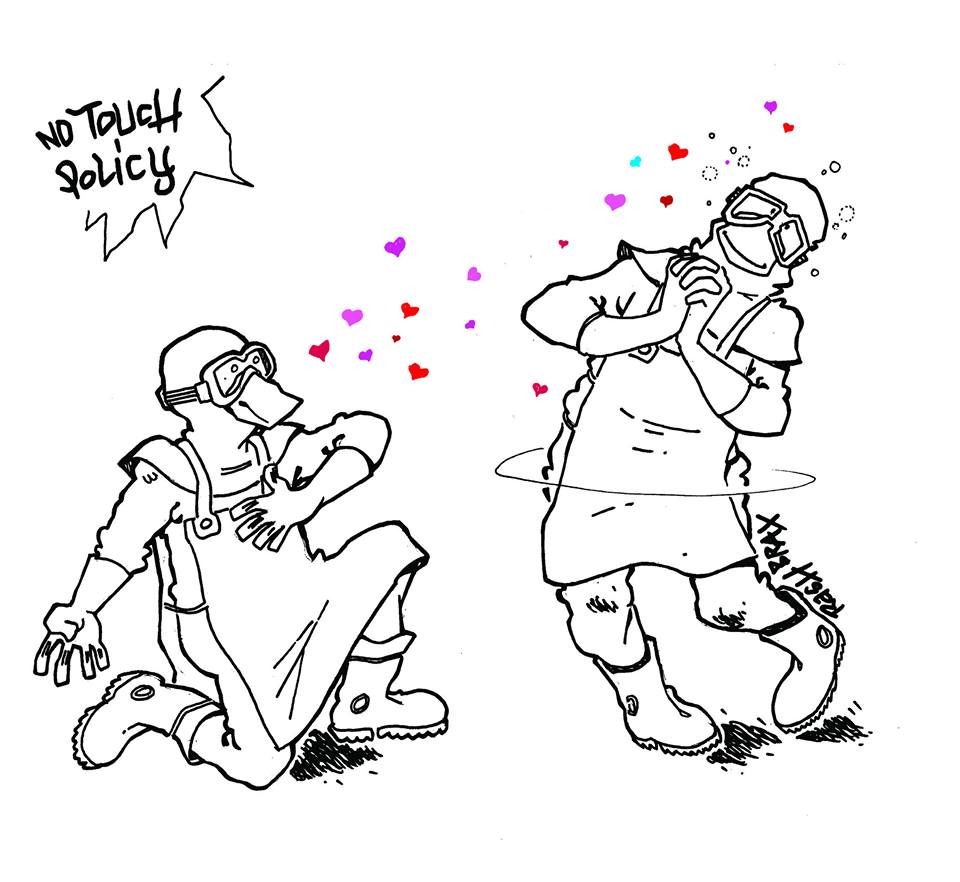
In practice, this submission to the organisation takes the form of security rules; depending on the situation: curfew from 6 p.m. onwards, restriction of access areas, prohibition of walking in the streets, prohibition of talking ‘politics’ with the locals, prohibition of drinking alcohol, prohibition of having sentimental relationships with the staff, etc. On Ebola missions, as now on many missions during the COVID period, the so-called ‘no touch policy’[4] prohibits touching anyone at any time of the day or evening: no handshaking, no eye-scratching, no kissing, etc.
Figure 1: Cartoonist Brax’s caricature of the ‘no touch policy’
1.2. Continuous community life
As far as accommodation is concerned, the expatriates never really leave the organisation. In the afternoon, when they finish the daily activity for which they have been sent on mission —whether they are logisticians, doctors, or administrators—, they do not return home but to premises managed by MSF: houses, flats, tents, shared rooms, etc.
Sometimes everyone has its own room, but in other situations, as in the following photograph from another project in Bangui, also in 2014, the room is shared with colleagues. In still other situations, such as in the 2013 yaws treatment campaign in Congo-Brazzaville, the night is spent in a collective tent. And even when expatriates are housed in buildings and have individual rooms, the other spaces are nevertheless shared: kitchen, living room, gym, garden, etc. After their day’s work, expatriates live together as a community and usually gather around the same table for a meal. In 2014, at the Bangui General Hospital in the Central African Republic, the expatriates set up a wing of the hospital for leisure activities. Thus, the roof became a place of conviviality, a reconstructed bar, where barbecues were regularly organised in the evenings and at weekends.
Figure 2: Room shared by two expatriates in the Central African Republic
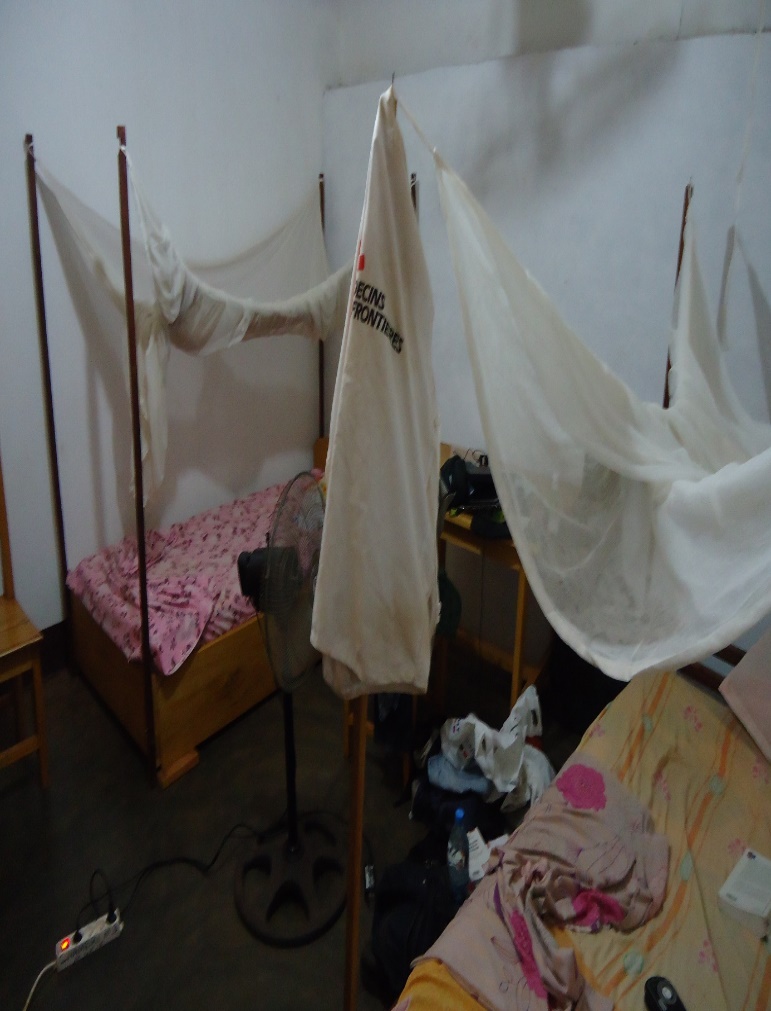
Photo: L. Joxe.
1.3. Flexible working hours
Working hours[5] are partly symbolic. Although office hours and medical schedules are constrained by local labour laws or security regulations, these apply, above all, to national staff. In Nyarugusu, Tanzania, the responsible for the High Commissioner for Refugees required the MSF team to leave the camp by 5 p.m. at the latest. Local staff members would then return to their family homes to spend the evening with their families. But the expatriates, after a day in the office, hospital or medical centre, return to their shared accommodation and not always stop working. In Karachi, Pakistan, in 2020, after a Wednesday’s work officially ended at 5 p.m., the whole team gathered around the living room table until 11 p.m. to prepare the budget for the year 2021. Everyone then went to bed to meet again at 7 a.m. the next morning for breakfast and then went to the office. On the following Sunday morning, the logistician had to organise, together with a driver and the radio operator, the reception of two procurement officers at the airport. Two hours later, I, the project coordinator, had to welcome these visitors and explain the functioning of the house (toilets, food, linen, etc.) and give them the first briefings about security rules. The arrival and departure of expatriates at the beginning or end of the mission, the arrival and departure of holidaymakers, visits from local members of the organisation’s headquarters or the coordination team ‘in the capital’[6], as well as night meetings between expatriates on the team or by videocall with referents from headquarters or the coordination team, and even the arrival of trucks full of logistical or medical items at any time: all of these are frequent outside ‘office hours’. Depending on the nature of the project, the teams are also likely to be mobilised at all hours. Often, one or more cars and their drivers remain on stand-by, ready to leave if necessary. In Epulu, Democratic Republic of Congo (DRC), in 2020, some colleagues knocked on my bedroom door at 11 p.m. because rocks had just been thrown at our infrastructure. In Gambella, Ethiopia, in 2012, the guards woke me up in the middle of the night because a pregnant patient we were temporarily housing in a hotel in the city had unexpectedly broken her waters. In Bangui, Central African Republic, in 2014, gunfire broke out at night and we had to take cover in an armoured room. In all these situations, the expatriate remains subject to the organisation and the conditions of his or her mission, whatever the day or the hour.
1.4. A blurred boundary between colleagues and family
Furthermore, although some expatriates claim to make a clear distinction between an individual as ‘work colleague’ during the day, and the same individual as a ‘friend’ or ‘roommate’ in the evening, in practice this seems different. Given the continuity of activities between day and evening and the proximity of places and activities, the quality of the atmosphere felt ‘at home’ has an impact on the quality of the atmosphere during the day at work and vice versa. Several expatriates spoke to me about the ‘MSF family’, with all the ambiguity that such a term can cover: both a space of comfort and a space of tension. This term is reminiscent of the metaphorical vocabulary that Marion Fresia had already noted in relation to the UN High Commissioner for Refugees, another humanitarian organisation based on a mission logic: ‘the home’ to designate the headquarters, ‘the field’ to designate the mission location, ‘the family’ to designate the expatriate community (Fresia, 2009, p.177). In the evening, over a beer at home or in the local bar, expatriates share and vent their emotions, listening to each other. The following photo is a 2015 Christmas meal in Tanzania: the project expatriates are all gathered around the communal table to spend this moment traditionally associated with family and loved ones.
Figure 3: Christmas meal in Tanzania, 2015
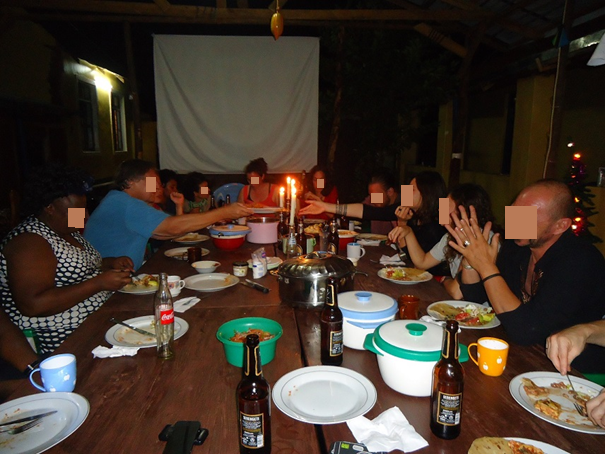
Photo: L. Joxe.
1.5. Health at work or health ‘in general’?
As far as health is concerned, here again the line between work and non-work is blurred. The physical concerns of expatriates, whether related to working hours or not, are first treated in the field by the project’s medical manager or, in the event of a specific need, by an officer at headquarters. All aspects of the expatriate’s physical health are thus delegated to the organisation for several months. This is also the case with psychological concerns. Although there is a long-standing tradition in humanitarian work according to which complaining about one’s own suffering would be out of place in the face of the suffering of the ‘beneficiaries’ (Vaux, 2001, p.7), attitudes are changing. Even on this intimate subject, the organisation now asserts its presence. The Belgian section of MSF has set up services to support expatriates who express the need: support by psychologists (remotely and 24 hours a day), by peers (former MSF expatriates talk voluntarily with those on mission), or by the hierarchy. In 2019, the Belgian section prepared a document called I feel good, which aims to address the psychological challenges of life on mission.
Figure 4: I feel good manual written in 2019
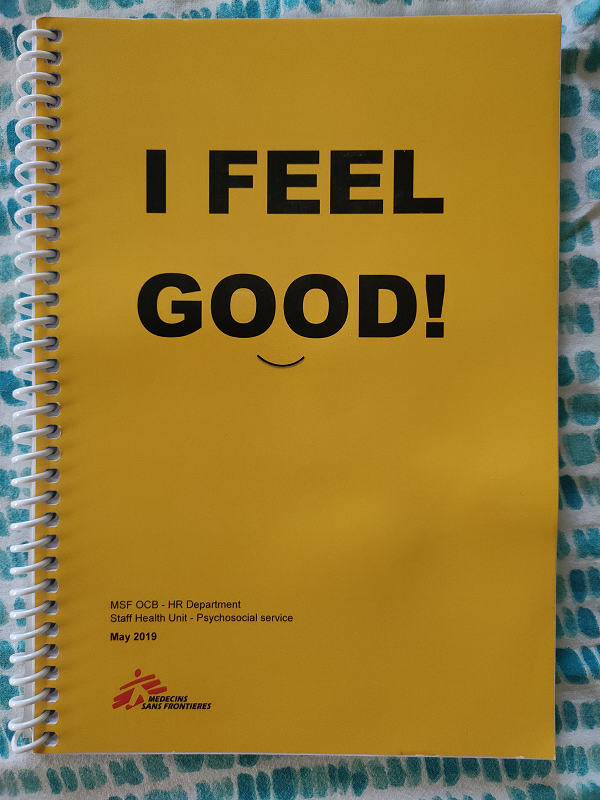
Photo: L. Joxe.
In 2016, the Belgian section had already published a guide for project coordinators entitled ‘Stress management and prevention: the role of the project coordinator’[7]. As a symbol of this holistic approach, only one of the eleven parts of the guide deals with ‘critical’ and/or traumatic incidents, such as road accidents, robberies, or kidnappings. The other ten parts deal with more general issues related to community life, and in particular the satisfaction of expatriates’ ‘physiological needs’, ‘control needs’ or ‘belonging needs’. Psychological support is thus not only concerned with ‘catastrophic’ emotional shocks (as was the case some twenty years ago) but more generally with living conditions, working conditions, and satisfaction during the mission. The blurring of the distinction between health and occupational health, whether physical or psychological, is a further illustration of the presence of the organisation in the expatriate’s daily life throughout the assignment.
Finally, whether it is through the extensiveness of security rules, the flexibility of schedules, community life, or the global nature of health care, this first part has shown how the organisation interferes with the expatriate’s life during a humanitarian mission. As Marc Loriol has noted with regard to diplomats (Loriol, 2016), this raises the question of the boundaries of intimacy and, more broadly, the boundaries between spaces perceived as constrained and those considered to be free.
2. Preserving spaces of freedom?
In these humanitarian missions, where the working day really never ends, where security rules apply day and night, where colleagues also become close friends, what are the moments when the expatriate finally considers himself free from the control of the organisation? To answer this question, I describe here three types of freedom spaces: daily refuge spaces, temporary leave spaces granted by MSF over the course of a mission, and inter-contract spaces between two missions.
2.1. On-site daily refuge spaces
On a daily basis, expatriates try to reconstitute personal spaces in which the organisation may not interfere: spaces of non-work within work, of non-control within control, of non-organisation within the organisation, of non-employer within their job. These spaces, which I call refuge spaces, are very important as expatriates have sometimes experienced difficulties, frustration, and stress during their day and feel the need to escape. What are the conditions for the existence of these spaces? To what extent do they allow for privacy? What activities are associated with these spaces?
First of all, during humanitarian missions at MSF, activities outside of working hours are, contrary to ‘classic’ off-duty activities, free of domestic tasks. In order to encourage expatriates to have time for themselves, the organisation employs cooks and cleaners in almost all projects to do the shopping, prepare meals, wash up, and do the laundry. In addition, the organisation has increasingly systematic budget lines to finance recreational equipment. Depending on the strictness of the security rules and the duration of the projects (sometimes several years), MSF officials invest in fitness machines, buy board games and even video game consoles, and sometimes get the project members a guitar.
Figure 5. MSF expatriates in Pakistan playing the video game Just Dance

Photo: L. Joxe.
Right upon returning from their day’s work, some of them play sports within the limits of the project’s security rules, sometimes running between the house and the walled enclosure surrounding it, other times in the project village or town or inside the house, using the fitness machines bought by MSF. Others watch television, or play music or board games. There are some who lock themselves in their rooms (if the project allows for single rooms) until the next morning to watch films, write, read, or communicate with their relatives in their home country[8]. Others turn to addictions, alone or with their colleagues: strong alcohol, beer, cigarettes, marijuana. Although little mentioned in interviews, sex also seems to be present, whether between expatriates, with national staff, or with prostitutes[9] [10]. Others go out to bars in the evening, when the geography of the project allows it.
These refuge spaces are not viewed in the same way by all expatriates. Depending on their original motivations, some will defend an unlimited availability to the organisation. These people have a classic vision of the humanitarian worker as a volunteer who, according to MSF’s own Charter, ‘[takes] the risks and dangers of the missions he/she carries out and will not claim any compensation for himself/herself or his/her beneficiaries’. This is the vision —perhaps cartoonish but still present in some minds— of the humanitarian worker ready to sacrifice himself to complete his task. For these people, there are no timetables; the MSF expatriate is supposed to be ready to respond to the constraints of the project at any time.
Others will, on the contrary, demand refuge spaces, both for themselves and for their colleagues, considering that these spaces and the associated activities are the sine qua non for their good physical and mental health and the proper completion of their mission. They will explicitly ask for minimal disturbance in the evenings and at weekends. Whatever their responsibilities, they will not hesitate to ignore their e-mails outside official working hours. The emergency can, in their view, wait. This may be seen by advocates of voluntary humanitarianism as a lack of flexibility and commitment to the supposedly common humanitarian cause. In other words, those who perceive their work with MSF as a job of passion will have less need to recreate spaces of freedom and allow themselves refuge activities than those for whom the work with MSF is more of a remunerative job, allowing them to feed their relatives in their country of origin.
2.2. Temporary leave spaces, between two worlds
In addition to the daily refuge spaces, the organisation regularly grants its expatriates days off. Although these can be imagined as true spaces of freedom, they are nevertheless partially constrained.
Every six weeks, the expatriate is contractually entitled to a weekend off. MSF field managers then try, as far as possible, to send the expatriate to the country’s capital and offer him or her two days in a hotel, away from colleagues. But the realities of the field, whether it is the urgency or the isolation of certain projects, do not always allow this. At the end of 2019, in Epulu in the DRC, under the pretext of the Ebola emergency, an expatriate responsible for sanitation regularly postponed his weekend off. Several weeks late, he ended up spending it, along with a public holiday, in a small hostel in the nearest town, Mambasa, a five-hour drive away.
Every three months, the expatriate is also contractually entitled to a week’s holiday, during which he/she designates a project colleague to delegate responsibilities and who will be in charge of his/her work telephone and computer. There are three options. If MSF deems that the political or security situation allows it, the expatriate can first travel to other areas of the country that are considered safe. On mission in Colombia in 2011 and Ethiopia in 2012, I was able to travel around these countries during my leave. If the political and security situation in the country is deemed too unstable by MSF, the expatriate must then spend his/her holidays abroad, usually in a neighbouring country deemed ‘safe’. In Pakistan in 2020, my expatriate colleagues went to Thailand, the Maldives or Turkey for their holidays. Although some expatriates sometimes manage to return to their home countries, the time frame is often too short. In Dungass, Niger, in 2016, the Congolese medical officer in charge of the project wanted to return home for the baptism of his child. Considering the car journeys and the various plane changes, it would have taken three days to get there and three days to get back. The medical officer finally spent his holiday in a hotel in Niamey, the capital of Niger.
Although weekends or weeks off constitute a time of non-work in the sense that the expatriate is effectively free from security rules, e-mails and other burdens of humanitarian activity, during a time for leisure and rest, they rarely allow for personal development or family reunions, other classic characteristics of off-work time, and are nonetheless partly constrained by the organisation.
2.3. Spaces between two missions, at home
The ‘real’ off-work time —when MSF can finally disappear and the individual can return to his/her country, friends, and family, and carry out other activities— would be the time between missions. However, this inter-mission space varies according to the individuals and the jobs performed within the organisation.
According to the most classic vision of off-work life, this time between assignments effectively allows some expatriates to refocus on themselves and their private lives. It also allows them to share their field experience with their family and friends. This time away from work confirms their social status and consolidates their recognition as humanitarian workers. For example, Fabienne, a Cameroonian pharmacist, is reunited with her young children when she returns home. Suzie, a logistician, tells me: ‘I put my heart into it for six months or more, and then I don’t do anything for three months, I only think about myself. That’s exactly what I need’. However, the temporary nature of the return to their country of origin compromises their ability to engage in periodic activities, anchored in a monthly calendar: sports, music, art, or evening classes, for example. Expatriates thus become a kind of temporary or intermittent humanitarian worker. With a succession of fixed-term contracts and, in the French case, periods of unemployment, their official status is so changeable that the administration sometimes has difficulty keeping up. Their work with MSF thus imposes particular rhythms on their lives and a desynchronisation of their social life, as the literature on atypical working hours has already observed (Staines and Pleck, 1984; Presser, 2003; Strazdins et al., 2006; Täht and Mills, 2016).
For other expatriates, their commitment to MSF does not cease between missions. Many of them volunteer in their home country to participate in MSF events: the annual headquarters party, photo exhibitions, happenings in public places to raise awareness about humanitarian, etc. Not to mention those who are in a relationship with an MSF member or those who work in the organisation’s local office closest to their home, share a drink, meals or trips with other expatriates, volunteer as ‘peers’ to chat freely with expatriates on their return from a mission, or take part in the organisation’s board meetings, general assemblies, or news feeds by e-mail or on social networks. Others do short replacements at headquarters, carry out one-off research missions, develop an activity on behalf of the organisation, or take part in training courses set up by MSF[11]. In all these situations, the concerned expatriates never really leave MSF. They maintain a strong link with the organisation, even between their field missions.
Finally, for some expatriates, when their mission with MSF ends and they are supposed to finally experience the ‘real’ off-work time, they in fact have to return to another job. The most specialised doctors, surgeons and anaesthetists in particular, often carry out their humanitarian mission with MSF during the holidays from their permanent position in a hospital in their own country, perceiving their activity with MSF as a parenthesis. While the return to the hospital is, from MSF’s point of view, time away from work, it is actually, from the point of view of their home hospital, working time. In my case, I did my last seven missions during the summer and Christmas periods of my thesis. During my thesis holidays, my ‘off-thesis’ was the activity with MSF, and my ‘off-MSF’ was my thesis: the off-work time of one turned out to be the working time of the other, and vice versa.
Thus, if work is supposed to provide social status and if non-work allows for self-expression, then the distinction between the notions of work and non-work is, for these expatriates, blurred. As with workers who have multiple jobs (Barbe, 2017), one day’s social status is not necessarily the next day’s, and self-expression seems to take place in one activity as well as the other. For these expatriates, this situation reinforces the feeling of playing temporary roles. A Czech logistician, in charge of hundreds of MSF employees in Palestine, told me that between missions he returned to his job as an electrician in a public construction company. An MSF medical manager, on whom a hundred or so people in the humanitarian field regularly depend, works between missions as a midwife in a hospital in Normandy. For my part, I am a project coordinator at MSF, being responsible for more than 500 people at times, but when I return to France, I am sometimes unemployed, sometimes a doctoral student or a teacher at the bottom of the academic hierarchy. On the other hand, some people have great responsibilities in their country of origin: lawyers or heads of department at a hospital, for example, but they become administrators or simple doctors on MSF projects.
Finally, it seems possible to distinguish between a kind of ‘intermediate off-work time’ in the evening while on mission, and an off-work time, in its more traditional sense and from MSF’s point of view, between missions: a distinction that corresponds to a reality effectively felt as such by many expatriates, but which also remains fragile. Indeed, the three types of freedom spaces described here (refuge spaces, leave spaces, spaces between missions) show both the way in which the organisation can maintain a form of presence in each of these spaces, and how the expatriate can, in all these situations, preserve a share of intimacy and MSF-independent life. The description of these three types of freedom spaces shows how the expatriate can personally define and choose the off-work life that suits him/her.
Conclusion
In MSF humanitarian missions, the notion of off-work life, in the sense of time away from the employer, is blurred for several reasons: due to the content of the contract, which specifies a kind of exception for the humanitarian activity; the very accommodation shared with colleagues; the indistinction between colleagues, friends and family; the flexible working hours; the ever-present safety rules; and the delegation of mental and physical health to the organisation.
The idea of off-work life is ultimately blurred by a motive underlying all the reasons stated here: the challenge of defining the word ‘work’, a challenge even more evident in the voluntary sector. For the most committed expatriates, those who abandon themselves to MSF, committing their lives to work and for whom work is a means of personal fulfilment, the distinction between the private and public spheres is irrelevant, and the division between work and non-work loses its meaning. For the more professional people, who basically work as a living and to fulfil themselves in other ways, clearly distinguishing between work and non-work remains important. When some expatriates demand more respect for their non-working hours and greater comfort in the field, while others fight for an unlimited dedication, two visions of humanitarian work —one, as profession; the other, as commitment— and two visions of the notion of work —one, as binding; the other, as fulfilment— clash. In other words, the notion of off-work life loses its meaning when work is no longer seen as an arduous activity, but as a source of sense and pleasure.
Bibliography
Barbe M., 2017, Profession Slasheur : Cumuler les jobs un métier d’avenir, Paris, Marabout.
Barel Y. et Frémeaux S., 2005, “Perceptions par les salariés des mesures d’aide à la conciliation travail-hors-travail”, 16e conférence AGRH, Paris Dauphine, 15 et 16 septembre.
Barthe B., Gadbois C., Prunier-Poulmaire S. et Quéinnec Y., 2004, “Travailler en horaires atypiques”, in P. Falzon (dir.), Ergonomie, Paris, PUF, 129‑144. https://bit.ly/3a7ANO9
Fresia M., 2009, “Une élite transnationale : la fabrique d’une identité professionnelle chez les fonctionnaires du Haut Commissariat des Nations Unies aux Réfugiés”, Revue européenne des migrations internationales, vol. 25, n° 3, 167‑190.
Godechot O., Lurol M. et Méda D., 1999, “Des actifs à la recherche d’un nouvel équilibre entre travail et hors-travail”, Premières synthèses, n° 20.1.
Goldfinger C., 1998, Travail et hors-travail : vers une société fluide, Paris, Odile Jacob.
Houssin D., 2006, “L’urgence”, Les Tribunes de la santé, vol. 13, n° 4, 33‑38. https://bit.ly/2YkC137
Jamal M., 2004, “Burnout, Stress and Health of Employees on Non-Standard Work Schedules: A Study of Canadian Workers”, Stress and Health, vol. 20, n° 3, 113‑119. https://bit.ly/3qXOwhr
Kajantie E. et Phillips David I. W., 2006, “The effects of sex and hormonal status on the physiological response to acute psychosocial stress”, Psychoneuroendocrinology, vol. 31, n° 2, 151-178.
Kaler A. et Parkins J. R., 2018, “Talking about Time: Temporality and Motivation for International Christian Humanitarian Actors in South Sudan”, The British Journal of Sociology, vol. 69, n° 4, 1313‑1336.
Lafortune J.-M., 2004, Introduction aux analyses sociologiques du temps hors travail, Québec, Presses de l’Université de Québec.
Loriol M., 2016, “Le travail diplomatique et l’intime”, Socio. La nouvelle revue des sciences sociales, n° 7, 45‑64. https://bit.ly/3iPPaL8
McEwen B. S., 2002, “Sex, stress and the hippocampus: allostasis, allostatic load and the aging process”, Neurobiology of aging, vol. 23, n° 5, 921-939.
Méda D., [1995] 2010, Le Travail, une valeur en voie de disparition ?, Paris, Flammarion.
Menger P.-M., 2009, Le travail créateur. S’accomplir dans l’incertain, Paris, Gallimard-Seuil.
Näsholm M. H., 2012, “Global careerists’ identity construction: A narrative study of repeat expatriates and international itinerants”, International Journal of Managing Projects in Business, vol. 5, n° 4, 804‑812.
Naville P., 1957, De l’aliénation à la jouissance : la genèse de la sociologie du travail chez Marx et Engels, Paris, Librairie Marcel Rivière.
Ollier-Malaterre A., 2008, “Comment les employeurs appréhendent-ils la vie hors travail de leurs salariés ? Une comparaison entre le modèle français et le modèle anglo-américain”. Revue des politiques sociales et familiales, n° 92, 47‑60. http://bit.ly/3iUB3E4
Presser, H. B, 2003, Working in a 24/7 Economy: Challenges for American Families, New York, Russell Sage Foundation.
Staines G. L. et Pleck J. H., 1984, “Nonstandard work schedules and family life”, Journal of Applied Psychology, vol. 69, n° 3, 515.
Strazdins L., Clements M. S., Korda R. J., Broom D. H. et D’Souza R. M., 2006, “Unsociable work? Nonstandard work schedules, family relationships, and children’s well-being”, Journal of Marriage and Family, vol. 68, n° 2, 394-410.
Täht K. et Mills M., 2016, Out of Time: The Consequences of Non-Standard Employment Schedules for Family Cohesion, Dordrecht, Springer. https://bit.ly/3iUwNEY
Vatin F., 2014, Le travail : activité productive et ordre social, Nanterre, Presses universitaires de Paris Ouest.
Vaux T., 2001, The Selfish Altruist: Relief Work in Famine and War, London, Routledge.
- University of Paris-Descartes, CEPED.↵
- In 2019, MSF announced that it was running around 470 projects in over 70 countries. These included malaria, malnutrition, access to primary health care, and AIDS.↵
- On the notion of work, it is interesting to read: Naville (1957); Menger (2009); Méda ([1995], 2010); Vatin (2014).↵
- Originally in English (TN).↵
- By ‘working hours’, I mean here both the office hours of the caregivers, the accountant, or the human resources manager, and the medical schedules, which apply to doctors, nurses or midwives, for example.↵
- Coordination is the term used for the organisation’s teams in the capital of the country of intervention. These teams act as an interface between headquarters and the field. They manage, among other things, political relations at the national level or the supply chain for equipment and medicines.↵
- ‘Stress prevention and management: the role of the Project Coordinator’, November 2016 –1st edition, MSF OCB (Operational Center Brussels).↵
- This has become easier in recent years, as the Internet has become more widespread.↵
- Again, project security rules may explicitly prohibit visiting prostitutes or having romantic relationships with national staff, but practice may depart from the rules.↵
- In psychology, sexuality has been associated with the possibility of relieving stress (McEwen, 2002; Kajantie and Phillips, 2006).↵
- The (unpaid) training courses offered are very numerous and concern all the medical humanitarian professions: ‘populations in precarious situations’, ‘hospital management’, ‘training for accountants’, ‘supply chain’, etc.↵


