


Pedro Calderón Henríquez’s 1745 Proposal for the Pacific Rim
Marie Christine Duggan and Kathleen Harper[1]
Introduction: Research Question and Significance
Hispanic mercantile actors in Asia had been sailing between Cape Mendocino and Cabo San Lucas for two hundred years prior to the 1769 settlement of California by Spain, yet conventional wisdom is that they had no impact on Spain’s decision to occupy the region.[2] New archival evidence illustrates that, in 1745, a Manila actor proposed a mission in Japan, a shipyard in Monterey (California), and a fleet to protect the China trade route in the Pacific from the Russians, the Dutch and the English. The proposal becomes meaningful if we consider that he served in the King’s Council of the Indies in Madrid from 1766to 1776, precisely when the shipyard at San Blas was founded, the order to occupy Monterey was given, and an expedition was sent to claim territory in the Pacific Northwest to preempt Russian expansion.
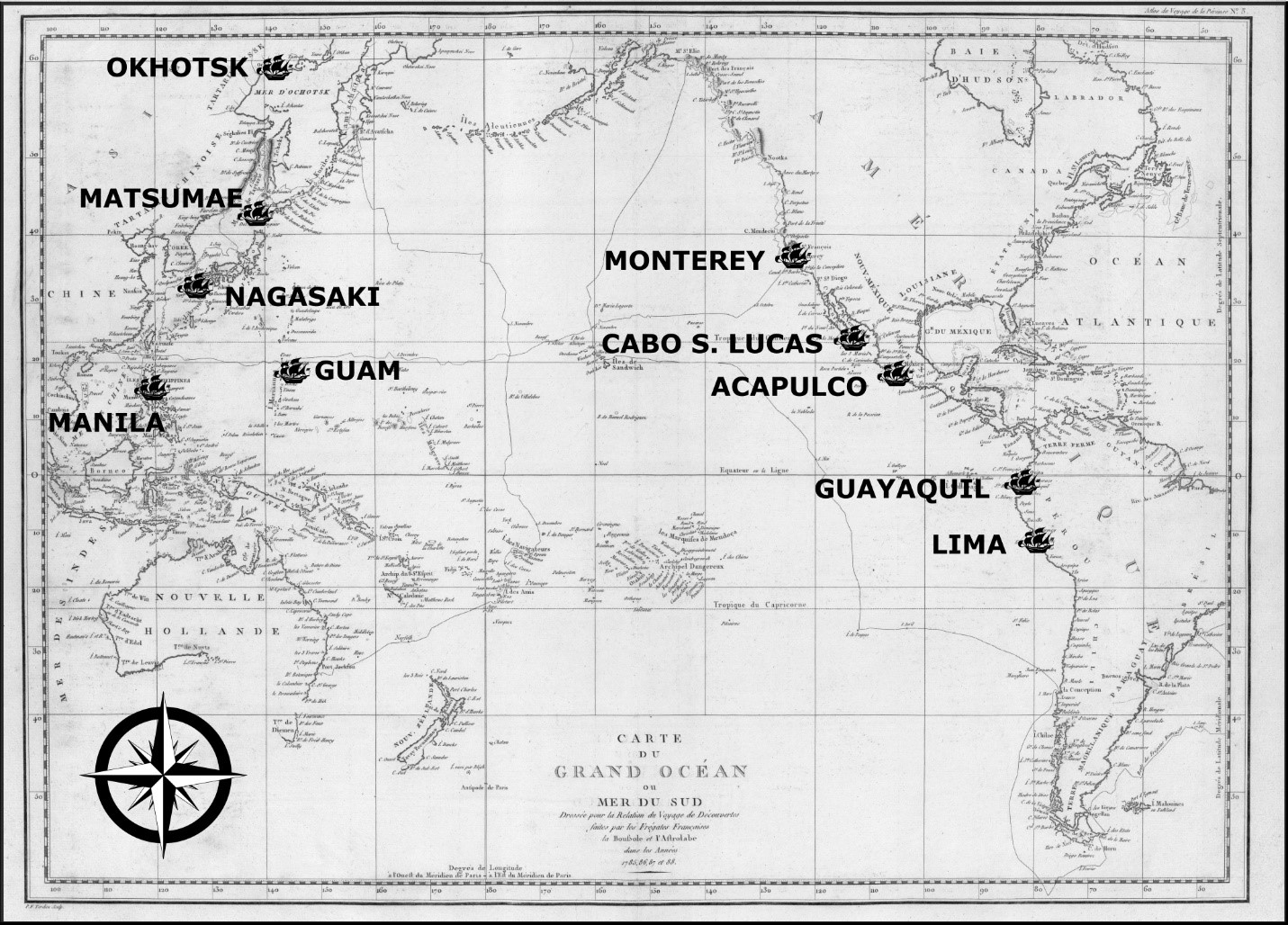
It is not hard to see why the influence of Spanish traders in China has been largely omitted. On the one hand, scholars of California and Baja California attribute development to the missionaries who traveled to the region from Mexico City.[3] On the other hand, research by Latin American scholars into 18th-century commerce of the Pacific tends to omit the western and northern legs of the Manila galleon circuit in the northern Pacific (Guam, Japan’s northern islands, Cape Mendocino to Cabo San Lucas, and Chacala to Acapulco), focusing instead on the triangle formed by Manila, Acapulco, and Lima.[4] By 1768, the actual triangular route of Spain’s China trade went from Manila north to Kamchatka, before turning south to make landfall in las Californias (Figure 1). By the mid-18th century, the Jesuits and the civil population of Baja California Sur found a lifeline in the trade with the Manila galleon.[5] Bernd Hausberger suggests that missionaries were never the first to arrive in a region: they were always preceded by someone else.[6] The fact that the Chumash in California’s Santa Barbara Channel spoke some Spanish phrases upon first meeting the Franciscans in 1769 was a clue that they had already met mariners passing by on their journey from Manila.[7]
When we look for a Hispanic actor in Manila with an interest in the northern Pacific, the literature already names him: the Cantabrian Pedro Calderón Henríquez, who served as oídor in Manila from 1737 to roughly 1765. The 1768 map in Figure 1 was drawn by Pedro Calderón while he served on the Council of the Indies in Madrid. Henry Raup Wagner published the map and its accompanying missive in 1944, and yet neither Calderón nor the mercantile community of which he was a member received further attention.[8] Wagner was a German-American rare book collector who spoke Spanish after decades of working for mining interests in Mexico and Chile. When introducing Calderón, Wagner believed that the Spanish had been misinformed about the galleon route, which Calderón shows as starting from the eastern side of the Philippines and heading through Guam, traveling north to the same latitude as Japan’s midpoint before his proposed stop at Monterey. In 1929, Wagner had translated much of Sebastian Vizcaíno’s account of his exploration voyage around northern California, and he knew that the early 17th-century galleon started from the west side of the Philippines, more precisely from Manila’s port of Cavite, and did not make a stop in Guam, but rather sailed directly north past Japan before turning east around a 41° latitude. In 1956, Lourdes Díaz-Trechuelo confirmed that Calderón’s drawing was accurate by noting that the changes to the galleon route proposed in the 1730s were finally implemented in the late 1760s, including a departure from the eastern side of the Philippines via Guam.[9] The British looting and occupation of Manila in 1762-64 inspired the Spanish Crown from 1765 to 1770, taking more seriously ideas for reform which had long been discussed in Manila.
Changes to the route were among the suggestions, including a stop in Monterey.
Figure 1. Calderón’s 1768 Derrotero (Route) Through the Northern Pacific[10]
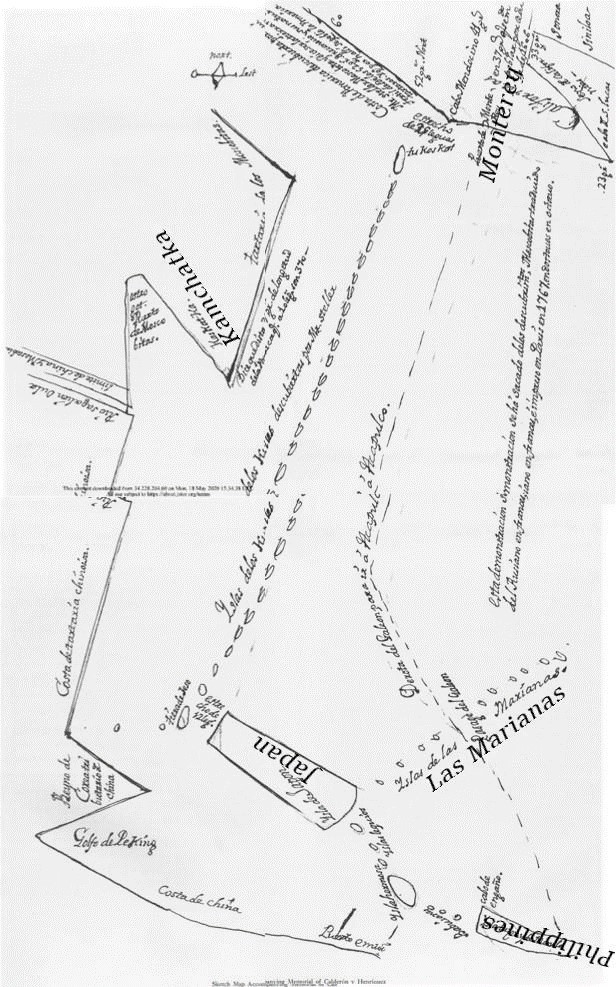
Calderón sent his map with the proposed stop in Monterey on April 14, 1768, to Manuel Roda y Arrieta, Marquis of Roda, who had served since 1765 as Charles III’s secretary of Gracias y Justicia. Like King Charles III, the Marquis of Roda had spent years in Italy, so he was an influential member of the inner circles of 1760s Madrid.[11] Calderón’s map is dated April 14, and we know that, already on January 23, 1768, Charles III had ordered that Monterey be occupied, an order which reached New Spain in May 1768.[12] Given that Calderón’s missive is dated after the King’s decree, it cannot be the immediate catalyst for the royal decree.[13] We do not know the specific conversations that transpired in Spain and led the Crown from a general sense that the Russians were a northern Pacific threat to a concrete order to carry out the occupation of California. Now that we know that Calderón had been writing on the topic since 1745, it is easy to imagine him disseminating missives with the same suggestions.
Between 1766 and 1774, the long-time resident of Manila served in Spain on the King’s Council of the Indies, and was thus well-placed to influence events precisely when the decision to occupy Monterey was taken.[14] As for his motives for advocating the vigilance and settlement of the northern Pacific Rim, we will use his detailed 1745 proposal to uncover them.[15]
Path-breaking research undertaken in Mexico City identifies Calderón as a member of a Cantabrian mercantile family that operated at the highest levels of the Spanish Empire. In 1745, Calderón identified the Dutch as the top threat to trade in the Pacific, which is surprising given that the English naval commander George Anson had seized the galleon Covadonga off the Philippine Islands in 1743. After resolving this paradox, we follow Calderón’s mental journey knocking out his mercantile competitors around the Pacific. A remarkable aspect of the 1745 proposal is Calderón’s knowledge of Russian activity in the Sea of Japan. We will explore how Calderón learned about Russian activity in northern Japan and the Americas, and then turn to his proposal for a mission in Japan, a shipyard in Monterey, and a fleet in the Pacific. His final blow would be against the Chinese merchants in Manila itself, and by usurping their position he imagines creating a managerial class of Spaniards in Manila, while also financing his larger vision.
In 1762, Pedro Calderón attempted to leave his office as oidor in Manila, planning to return to Spain via Acapulco. However, his voyage on the galleon Santissima Trinidad was foiled by storms, and when the ship lost its mast and returned to Manila seeking haven, the walled city had been occupied by the British East India Company, resulting in the British seizing the galleon. In the ensuing British looting of the ship and of Manila, Calderón personally lost $30,000 and was held for 19 days against his will. This is why Calderón’s return from Manila to Spain via Acapulco took place around 1765, leading him to serve on the Council of the Indies from 1766 to 1774. The Cantabrian with experience in Manila arrived in Madrid as a respected statesman with more knowledge of the Pacific than anyone else present, and was certainly well-placed between 1766 and 1768 to lobby ministers in Madrid toward a vision he had held for twenty-five years.
Who was Pedro Calderón?
Mexico City’s historian of Manila trade, Carmen Yuste López, revealed in 2007 that Pedro Calderón was related to José Gonzalez Calderón in the Consulado de México, and to José’s brother in Manila, Fernando González Calderón. Yuste bases the kinship on the fact that, in 1772, Pedro Calderón used his government connections in Madrid to ensure that Fernando’s widow in Manila (Ana Sancena) had permission to carry on the family business there. The González- Calderón family is an example of what Yuste names a “transpacific emporium,” with mercantile actors in both Mexico City and Manila, and with an oidor in Manila to lobby the governor and the Crown for pro-commercial policy.[16]
Guillermina del Valle Pavón, the historian of the 18th-century business community of Mexico City, explains the power of Don Pedro’s kin José González Calderón.[17] The merchant José was a Cantabrian who came to New Spain in 1737, the same year that Don Pedro arrived in Manila to advise the government as oidor. Outside of Mexico City, Don José owned a warehouse and the Hacienda de Santa Monica, whose labor force produced wheat and milled it into flour to supply the voracious demand of the city.[18] In 1761-1762, as prior for the Consulado de México, Don José was implicated in a scandal involving the sales tax which the businessmen’s guild had collected on behalf of the Crown. The amount collected exceeded the revenue sent to Spain, so that the prior of the Consulado controlled a fund of $1 million from which he made loans to his allies. Don José was not the first prior so implicated, rather he was the man in office when the practice came to light. Of course, sending the excess tax revenue to Spain would not have expanded the local economy, as investing the funds in mercantile activity in New Spain did—and certainly, the funds also benefited the prior and his friends, which is why the position was hotly contested and sought after. The Crown resolved the scandal by ordering that González Calderón and other merchants donate funds to build a warship and a hospital, and to refurbish a prison.
As prior between 1761 and 62, José González Calderón was the most powerful merchant in Mexico City in the year when the British looted Manila. We know that González shipped goods through the galleon every year after 1760, with an official load of $109,000 from Manila to Mexico City between 1765 and 1781.[19] The selling price of such goods in New Spain was ten times higher than the declared value, i.e., the Gonzalez Calderón family probably sold $1,000,000 of Asian imports in Mexico City over sixteen years, roughly equivalent to $40 million in 2023.[20] The reason for the low valuation of goods departing Manila is that the trade on the galleon was capped at $500,000 per year, distributed among some 25 to 30 merchants. The advantage of the Manila trade was that the very restrictions the Spanish state put on Asian imports resulted in scarcity, leading to a high-profit margin.
Valle Pavón tells us that the Spanish Empire’s mercantile community emanated from the northern coastline of New Spain, divided into Cantabrian and Basque factions.[21] The Calderón family had an entailed estate (mayorazgo) in Terán, Cantabria which was founded in 1661 by Pedro’s great-grandfather Sebastian Calderón Henríquez, who was then married to Antonia Mier y Terán. Pedro’s older brother Juan Antonio inherited the Calderón family estate in Terán, Cantabria, but he also inherited the Mier y Terán estate. Not needing both estates, Pedro’s nephew Francisco Manuel Calderón Henríquez sold the Calderón estate in Terán in 1764 to his uncle when the oidor returned from Manila to Spain.[22]
Pedro Calderón Henríquez operated in Manila from 1737 to 1764. It is intriguing that, in a 1748 document, Don Pedro complained that there wasn’t a single Spaniard in Manila “who could give 12,000 pesos as a dowry to his daughter,” perhaps an indication that the number of eligible young women in the city was smaller than the aristocratic bachelor had hoped for. In 1739, Don Pedro married María Teresa Fernández Toribio, daughter of the older Manila oidor, Francisco Fernández Toribio, to whom the Calderón Henríquez clan had a kinship tie.[23] Registered as a merchant, Don Francisco had control of the community funds of the Chinese Parián neighborhood, and perhaps Fernández was the source of Don Pedro’s detailed knowledge of Chinese guilds in his city. Around 1764, Don Pedro returned to Spain, where he served in the Council of the Indies from 1766 until his death in 1776.[24]
Below we analyze Pedro Calderón’s 1745 proposal to identify the reasons why merchants believed that the occupation of the Northern Pacific was critical to protecting mercantile profits for ships sailing from the Philippines past Japan towards Kamchatka and down to Monterey, Cabo San Lucas, and Acapulco. In doing so, we invite readers to open their eyes to the influence of Spanish commercial actors in Asia on the development of the Pacific American coast.
Part I: The Dutch as Threat
The immediate catalyst for Calderón’s 1745 proposal was the Dutch behavior between 1743 and 1745. In December 1743, a Dutch ship flying the Portuguese flag brought to Manila the news that the English naval commander George Anson had taken the galleon, whose Spanish captives the Dutch delivered to Manila. In June of that year, Anson had seized the west-bound Covadonga off the Philippines, along with a reputed cargo of over $1,000,000 in silver. At this time, such an act was legal because Spain and Britain were engaged in the War of Jenkins’ Ear (1739-1747). Calderón opens with a ringing call for Spain to defend Manila:
The Moors and the Dutch […] trade with your dominions with contempt […]. I fear that the Governor of Batavia, as he practiced with regard to affairs of India, in which he was earlier a lawyer, must insist upon introducing here at least a simulated business using another flag to the benefit of the Dutch, for whom he brought a dispensation for the Company [Dutch East India Company] from the prohibition which they hold, and by this means in six years he will exclude every other nation from this trade [India-Manila], putting to these residents whatever prices he wants.
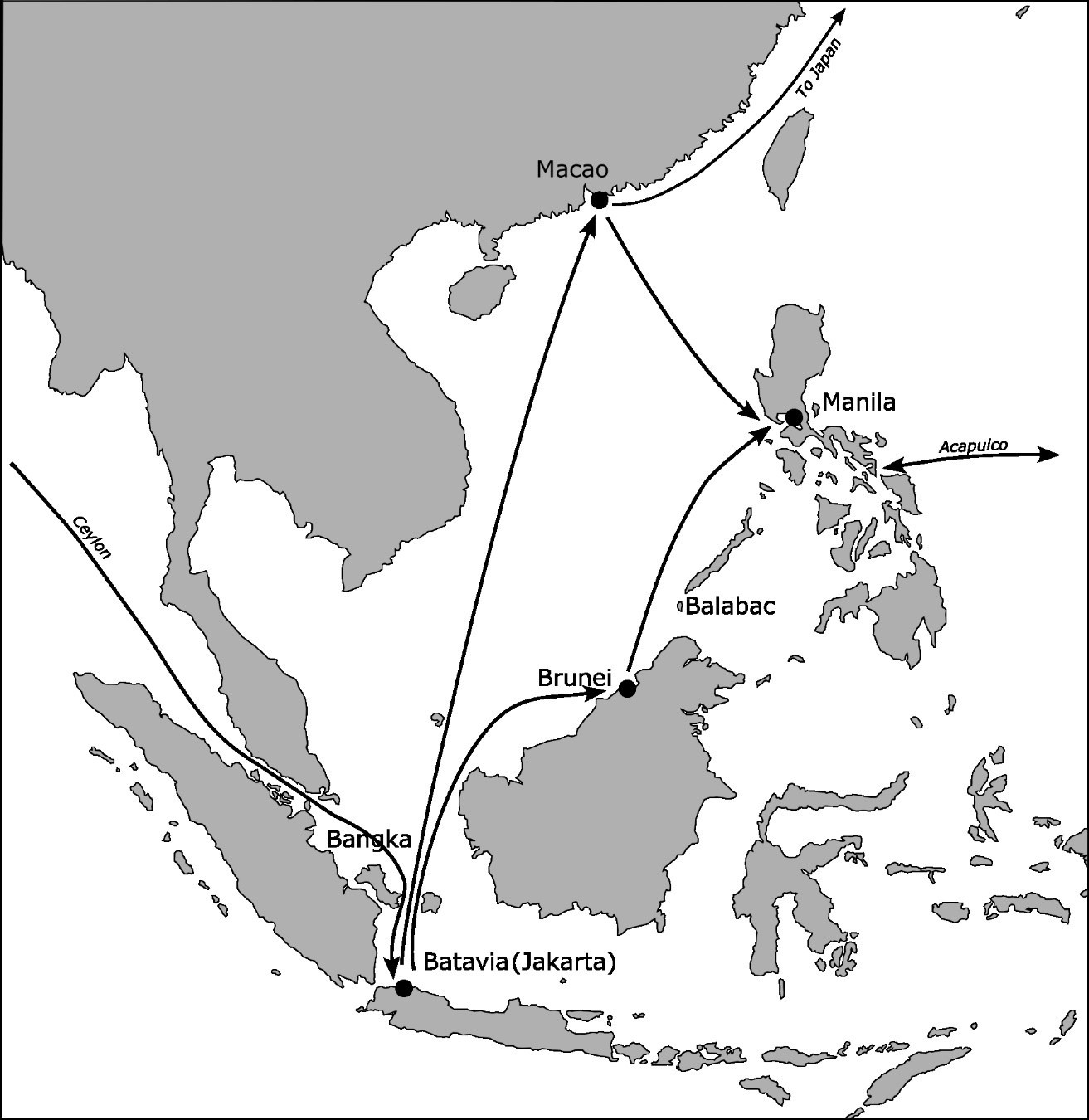
The Dutch hoped to profit from the conflict between the Spanish and the English by positing themselves as neutrals. Dutch merchants had long specialized in spices, which they traded to Manila by way of Muslims living in the Philippine Islands closest to Jakarta, where their colony of Batavia was headquartered (Figure 2). Trade between Jakarta and Manila under the official flag of the Dutch East India Company (VOC for its Dutch acronym) was forbidden. This ban paradoxically made the Philippine trade an attractive opportunity for Dutch actors who wished to undertake commercial voyages to line their own pockets, rather than to enrich the state. The “Governor of Batavia” to whom Calderón refers was Gustaf Willem, Baron van Imhoff, who governed Batavia from 1743 to 1750.[25]
In 1737, Baron van Imhoff had been governor of Ceylon, from which position he had witnessed the decline of the VOC including the loss of many ships. In 1741, he was in Holland to propose to the VOC directorate a revitalization program which involved recruiting new men from the navy to command the ships by means of higher pay, adding cannons to the ships for a militarization of the Dutch in Asia, and opening a school for navigators in Batavia. Van Imhoff funneled opportunities for lucrative trade on personal account to his protégés such as the Frenchman Jean Belleveau, captain of the Herstelder, who was paid only 1200 florins per year, but remitted 68,000 florins to Holland during his time in Batavia. Van Imhoff favored new styles of ships, and sailed in 1742 to Batavia on the Herstelder, which had been built in England.
In short, Van Imhoff was a competent and energetic force who intended to expand for-profit trade by the Dutch.[26] Calderón recognizes this when he predicts that in six years the Dutch will have taken over the supply trade in Asia. Perhaps Calderón’s reference to “India, in which he was earlier a lawyer” refers to Van Imhoff’s prior role as governor of Ceylon, from which the Dutch extracted very fine cinnamon which they sold to the Manila Spaniards for New Spain’s market in return for silver of the Americas. As upstream suppliers of the galleon, the Dutch experienced losses in 1742 and 1744 when the Spanish ship failed to sail.
Figure 2. Trade Routes of South Asia mentioned by Calderón in 1745[27]
In May 1744, Jan Louis de Win came as an envoy from Dutch Batavia to Manila for a six-month period with an offer to carry out the Manila-Acapulco trade on behalf of Spain, and to join the Spanish in the defense of Manila in the event that the English should attack.[28] Perhaps the Dutch were feeling the pinch of losing the Manila galleon as a customer. Governor Gaspar de la Torre of the Philippines refused Win’s offer. It is easy to see from Calderón’s 1745 proposal that the oidor viewed the Dutch as treacherous rivals who abetted the English enemy, and threatened the Mexico City-Manila merchants’ monopoly of the New Spain market for Asian products.[29]
In June 1745, the Dutch Governor Baron van Imhoff in Batavia decided to trade with New Spain even without Manila’s blessing. Van Imhoff sent three VOC ships as well as two English ships and a sixth vessel (for provisions) to carry one million pesos worth of goods to New Spain. The presence of British ships in the entourage reveals that the two Protestant powers were allies.
Van Imhoff led the Spaniards to believe that British pirates would attack a galleon should one depart Manila during the 1745 season, and this hint of threat succeeded in preventing Spanish merchants from sending the planned nao to New Spain.[30]
Van Imhoff’s planned 1745 transpacific fleet failed. Fortunately for the Spanish in Manila, the Dutch were delayed at Macao while picking up merchandise until September 14, while conventional wisdom is that August 15th is the last date for safe departure to catch the winds for America. Van Imhoff’s expedition returned to Batavia from Macao, battered by storms.[31]
The Dutch and the English
Like Cassandra, Calderón writes of British pirates the following lines:
All these corsairs have come to stop in China by passing through the Strait of Banca, in which one galleon of seventy cannons would be enough to hinder the passage of any squadron given the narrowness of the Channel, and they would not come so easily [to the Philippines] if they knew that we waited for them here with a squadron, however, [instead] they know of our abandonment.
Calderón’s words ring to posterity as prophetic given the defenseless state of Manila, afterward looted by the British military and the East India Company combined in 1762-64. Yet, in 1745, Calderón must have had on his mind the 1743 seizure of La Covadonga by Anson off the Philippine Islands, which had robbed Mexico City merchants and their consignees in Manila of over $1 million in silver pesos. This passage suggests that Calderón viewed Dutch friendship as the only way that the English could have managed to threaten Manila. In 1743, Anson had purchased provisions in Macao, which were crucial to his men’s ability to seize the Covadonga off the Philippines. The Dutch had granted Anson safe passage through the Strait of Bangka to reach China.[32] Calderón’s suggestion to protect Manila from British pirates is to place a ship with 70 cannons in the Dutch Strait of Bangka. Bangka is an island north of Sumatra, just west of Dutch Batavia, which looks out over a fairly narrow passage to China. By 1744, France had entered the War of Jenkins’ Ear as an ally of Spain against the British. While the war broke out in the Caribbean in 1739, its battles were liable to be fought all around the globe, wherever these major powers had outposts in proximity to one another. By 1745, the Dutch would declare war, too, against the French, which made the two Protestant powers allies. Calderón must have had the Anglo-Dutch collusion in mind when he wrote in 1745 that stationing a Manila Spanish ship at Bangka would prevent pirates from sailing to China, in effect preventing the Dutch from aiding and abetting Manila’s enemies.
When Calderón finally does mention the menace posed by English pirates, he points in a single paragraph to William Dampier, Woodes Rogers, John Clipperton, and George Anson. All these British pirates came around Cape Horn to Juan Fernandez Island off Chile in the first half of the 18th century, seizing ships along Peru’s coastline (seeking silver) and Guayaquil (a port rich in cocoa exports), then heading for Panama, Baja California Sur, Las Marianas, and then Manila, before continuing on to England by circumnavigating the globe. Calderón writes that it would be well to keep in Manila “four or five ships of forty and thirty cannons to cruise the Pacific” because then the following would result:
The English would not dare to do as they did in the year of 1705, harassing all of the Pacific with two ships of thirty cannons, making large seizures on the coast of Peru; they then took the galleon of these Islands, La Encarnacion, at Cabo San Lucas, and sacked the town of Guayaquil with only one hundred and sixty men […]. [They also sacked] Clipperton with just one ship of thirty cannons, made great seizures on the coast of Peru, and tried to take the flat-bottomed boat [patache] that was anchored at the port of the Marianas Islands. And finally, vice admiral Anson, with just one battered ship and a few people, seized from us the galleon Covadonga along with more than a million pesos, after he had caused damage by more than two million pesos on the coast of Peru.
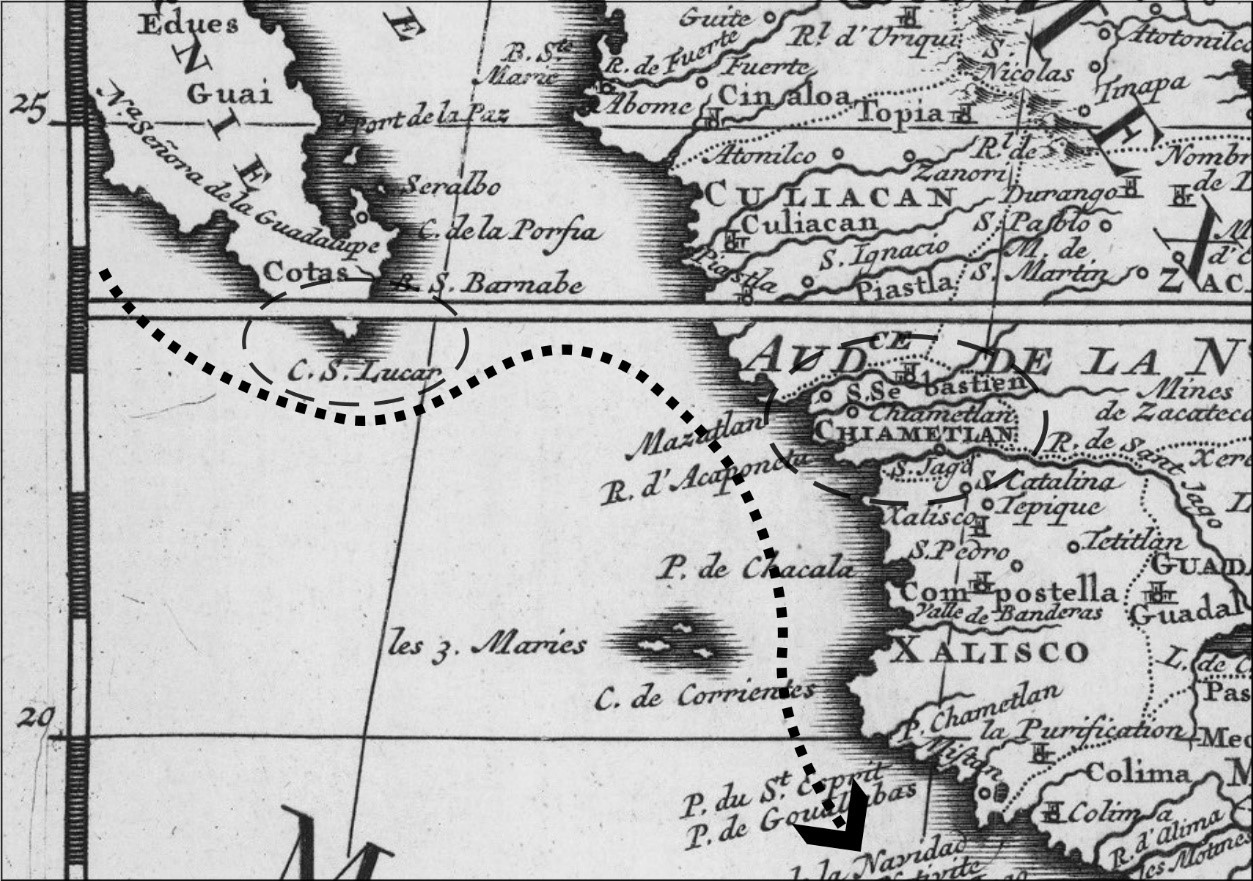
The area near Cabo San Lucas was a favorite place for pirates to lie in wait for the textile-laden galleon coming from Asia, or they could head for Las Marianas or the Philippines and lie in wait for the galleon from Acapulco loaded with silver.[33] Dampier’s 1704 attempt on a galleon at Chametla and Woods Rogers’ 1709 seizure of the Encarnacion at Cabo San Lucas brought home this point (see Figure 3). In 1732, the elites of Mexico City had donated the funds necessary to finance Jesuit missions in Baja California Sur, specifically through Mission San José del Cabo (see Figure 3 for the galleon’s passage through the region). In 1741-42, Guadalajara officials mobilized thousands of men and local mariners to watch for Anson at outlooks between Acaponeta and Huatulco, and indeed this system succeeded in preventing the Englishman from taking the galleon in New Spain.[34]
Figure 3. The galleon sailed between Cabo San Lucas and Cabo de Corrientes en route to Acapulco[35]
Yet British attacks off the Philippines were still a threat. In 1721, Clipperton’s seizure of a sloop in Las Marianas, and Anson’s successful 1743 seizure of the Covadonga with a full load of silver off the Philippines made obvious that the northern Pacific required a better system of defense. Perú had at times sent out a squadron, so Calderón’s call for “four or five” vessels based in Manila, yet patrolling California, was meant to encompass a very wide region.
Note here that, for Calderón, “California” would mean at times Cabo San Lucas, while at other times Monterey, a wording typical for 18th century New Spain, in which the term simply referred to the eastern side of the galleon’s route. Indeed, for him not only was the coast from Mendocino to Cabo San Lucas one unit, but the entire China trade route was a single continuous circle, which is why he held that ships built at Monterey, but based in Manila, could protect Cabo San Lucas as well as Las Marianas.
Part II: The Dutch as source of Information
Japan: Opportunity
The Manila actors’ depth of knowledge of the northern Pacific Rim is on display in Calderón’s discussion of trade between Hokkaido (Japan) and Russian Tartary. Seeking their source for such information takes us directly back to the Dutch. Between 1641 and 1843, the Dutch were the only Europeans allowed in Japan, and the Dutch envoy to Manila who arrived in December 1743 with Anson’s Spanish captives stayed for six months, which must have given Calderón the opportunity to probe for information.[36] Indeed, Jan Louis De Win had earlier served the Dutch in Nagasaki.[37] From Batavia (Jakarta), the Dutch shipped cotton and spices to Manila and Japan to trade them for silver and copper respectively (see Figures 2 and 4).
In 1745, Calderón proposed to set out from Manila to undertake the following:
To explore the coast that follows the Tsugaru Strait that divides Japan from the land of Heso and to establish very useful commerce in the heavy cloth and hides that are abundant in New Spain in the Port of Matsumae, situated upon this strait; there is much commerce because the Japanese, Koreans, and Tartars converge there.
Remarkably, Calderón knew that the Japanese Matsumae Clan had the authority to administer a small part of south Hokkaido on the Tsugaru strait, which divided the island from the main Japanese island of Honshu (see Figure 4). The 21st-century scholar of the region, Jun Uchida, tells us that, between 1741 and 1754, the Japanese merchants held a monopoly on the Matsumae export of dried sea cucumbers (iriko) to Nagasaki via the Sea of Japan, with the ultimate destination being China. Like Spanish America, the Japanese exported silver to China, and there was hope in Japan of developing alternative goods for export such as the sea cucumber business.[38] Calderón was correct that the heavy cloth and leather hides of New Spain might be more appreciated in the colder climate of northern Japan than in Manila or Canton. For the ship setting off from the Philippines and heading north to find the Kurosawa current, stopping at Hokkaido en route to New Spain would not have added any additional cost. In the eyes of the Manila oidor, the northern Japanese islands offered opportunities to obtain silver, iron, and furs, . The Jesuit mission in northern Hokkaido would also serve as an entrée for Manila’s merchants to access the medicinal drugs from Russia.
Figure 4. Russians and the Sea of Japan[39]
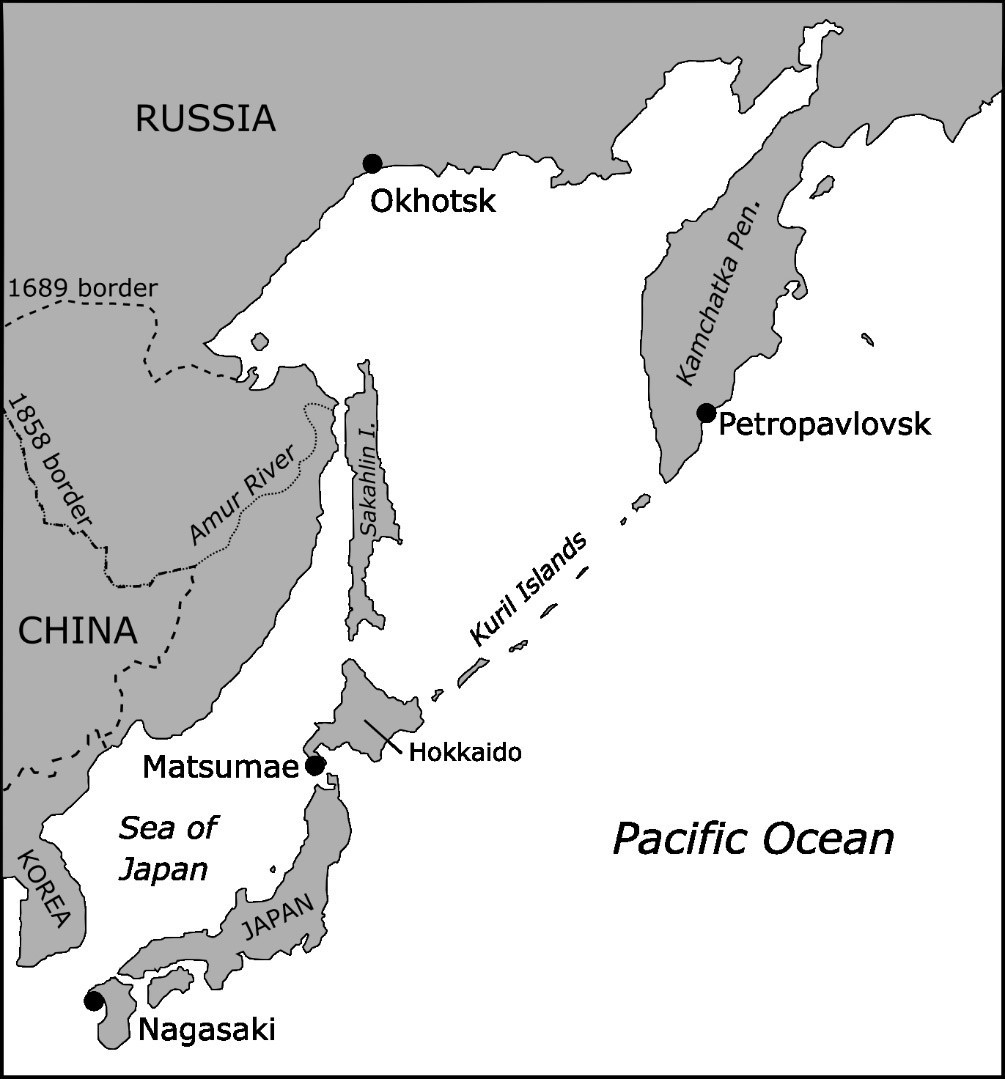
Russians in the Sea of Japan by 1745
Calderón segues from a discussion of Japan to the northeastern Pacific, linking California and the Russians in a single sentence:
A port populating the coast of the Californias, which has already been recognized by expert men, and declared by Your Majesty as most appropriate in the latitude of 37° […]. We would fortify that part of the Americas, against whatever attempt enemies might make, with special attention to the Russians who have already a port in the Pacific, or Sea of Tartary, and came down a few years ago to explore the Gulf of Japan, according to what the Dutch say…
To which Russian port in the Pacific was Calderón referring in the above quotation? In 1638, Russia established Okhotsk in the Sea of Okhotsk, yet the reference to the Sea of Tartary suggests the mouth of the Amur River.[40] Russians had, by the mid-17th century, arrived at the coast traveling overland along this river —which in 1858 was made the official border between China and Russia—, before turning north to reach the Pacific at the Strait of Tartary opposite Sakhalin Island (see Figure 4). By the 1720s, the Russians also had a settlement on the Kamchatka Peninsula, from which, in 1728, the Dane Vitus Bering and the Russian A.I. Chirikov explored the strait between Asia and America. Less well known is that, in 1730, Chirikov also proposed a route from Kamchatka to the Amur River. The dream for European Russia was to establish a maritime route to China by sailing from Arkhangelsk through the Bering Strait, west to Kamchatka, then southwest through the Strait of Tartary to the Amur River, to obtain Chinese products via the Sea of Japan.[41]
By 1745, the Spanish in Manila were aware of Russian plans to gain a share of what men such as Calderón considered Spain’s China trade. Calderón references Chirikov’s commander, Vitus Bering, who led the 1728 expedition to the strait separating Asia from the Americas which now bears his name:
According to the discovery which they [the Russians] attempted in the past year of one thousand seventeen hundred and twenty-eight by means of Captain Berings [sic], he had the particular charge of seeking our America, following the coast of Russian Tartary [from Kamchatka], which he carried out, navigating east north-east until sixty-seven and a half degrees north, and although he did not achieve this attempt, they can make use of these news in order to join [arrimarse] themselves easily to Cape Mendocino in the Californias.
When, in December 1724, Peter I authorized an expedition from Kamchatka to the strait between Asia and America, for which he appointed V.I. Bering in 1725, the Tsar’s immediate goal was to locate a new source of furs which could replenish his treasury, depleted by 21 years of war with Sweden. In June 1728, 44 men, including Bering and Chirikov, sailed on the ship Sv. Gavriil from Kamchatka to 67° latitude, reaching Chukotka Nose (the piece of Asia that reaches out toward the Americas). They learned that there existed islands between the two continents which could facilitate travel between them. Without glimpsing North America, Bering and Chirikov headed in August back to Kamchatka over winter. In 1732, the ship S. Gavriil sailed once again from Kamchatka to reach North America, not under Bering and Chirikov, but rather under M.S. Gvozdev and I. Fëdorov.[42] In that same year of 1732, Captain M.P. Shpanberg sailed from Kamchatka to the Kurils and Japan.[43]
Part III. Action Proposed from Manila
Mission in Japan
The island of Hokkaido was largely the domain of the indigenous Ainu in a region known as Ezo, who chafed under exploitation by the Japanese in their enclave at Matsumae. Given the tense relationship between the Ainu and the Japanese, Calderón’s vision of the Ainu welcoming an alliance with Spaniards out of Manila had some merit. The Manila oidor wrote:
The heavy cloth [paño] and hides that are abundant in New Spain are highly esteemed in those parts [Northern Japan], we could barter there for silver of the [Japanese] mines, iron and other fruits of Japan, and for roots and medicinal drugs, which the Tartars have, and for marten furs. And at the same time, we could return to introducing there the Scripture, to the Japanese and the Tartars, and in Korea, given that all those people worship idols, without there being in those parts either heretics or Muslims.
Calderón is describing a Jesuit mission in northern Japan, which would dovetail with the way merchants had established colonies in Las Marianas and Baja California Sur: by establishing pious endowments with this order from Northern Spain whose stream of interest staffed the missions.[44] By 1745, our actor in Spanish Manila learned from the Dutch of Bering’s 1728 expedition, and correctly concluded that the navigational knowledge gained would facilitate later Russian exploration of the Americas. Calderón not only spoke of Russian activities in the Americas, but also turned his eyes to Japan:
For the initial cost [of the port in California], the House will contribute what is necessary, and for its maintenance [and] discoveries and to tie these Dominions with those of the Americas with ports nearby in that part of Japan measures will be proposed without increasing the expenditures of the Royal Treasury.
Calderón wants not only to tie the Philippines to the Americas by means of the port in Monterey, but also to tie Monterey to northern Japan. The process of evangelizing is in Calderón’s eyes one that wins native people as allies to Spain. With missionaries negotiating such alliances in Japan and California, and Filipino workmen building ships in Monterey, Spain would hold Hokkaido and California against Mexico City merchants’ competitors for the northern Pacific. These competitors included the newly expanding Russians, but also the Dutch whom he suspected would try to use California as a means of trading in New Spain. Calderón was prescient because he wrote this in 1745 and the Dutch arrived in Baja California in 1746, where the presence of a welcoming Dutch-speaking missionary facilitated their recovery from the arduous journey, a subject to which we will return later.
Shipyard in Monterey
A shipyard in Monterey (California) is a critical piece of Calderón’s 1745 proposal, not only as a stop for the galleon but also as an inexpensive location for building the four or five ships that he envisions as patrolling the Pacific from the Strait of Bangka to Cabo San Lucas.
The House will take it under charge to provide a suitable stop [escala] for the relief of the naos which go to New Spain, [that is,] a port settling the coast of the Californias, which has already been recognized by expert men, and declared by Your Majesty as most appropriate in the latitude of 37 degrees, abundant with mountains, water, hemp, and many gentle people suited for the preaching of the Holy Gospel in the first land that these naos see and distant 40 days of navigation from Acapulco…[45]
The proposed stop at 37º latitude is of course Monterey. This 1745 proposal refers to Vizcaíno’s 1602 voyage when Calderón says that competent men have proposed the location as suitable, and he is referring to the August 19, 1606 order of the King to settle it.[46] That Monterey is 40 days out from Acapulco is helpful to understand what California means to the Manila-Mexico City merchant. As for hemp, red milkweed is the fiber that people in the Santa Barbara Channel used for rope.[47] He is correct that the California coast is mountainous and has water. Calderón continues:
With the development of this settlement the entire lengthy coast will be pacified, and the land penetrated, land which they say abounds in many heathen, to which end the House will maintain a presidio with soldiers, shipyard and fleet [maestranza y marinos] to build vessels, and to sail in them along that coast, a matter so easy from here, as it is unattainable from New Spain, because here we have more than enough men skilled in building ships and sailing [maestranza y marina], with the advantage of supplying itself with gunpowder, artillery, weapons and iron as cheaply as in Cádiz.
In 1602, Fr. Antonio de la Ascensión, who accompanied Sebastian Vizcaíno on his exploration of California’s coast wrote that “the Puerto de Monterey…is a very good port, and well-protected from all winds. There is much wood and water in it, and an immense number of great pine trees, smooth and straight, suitable for the masts and yards of ships; many very large live oaks with which to build ships; great white oaks, and forests of great scarlet oaks.”[48] If we keep these 1602 words in mind, we can understand why Monterey was attractive to Calderón as a naval shipyard. The 18th-century oidor envisioned the construction of vessels for a fleet to patrol the Pacific. Manila’s port of Cavite was home to skilled Filipino shipbuilders (“here we have more than enough men skilled in building ships”) and both then and now Filipino sailors are reputed to be among the best in the world. Calderón even points to the availability of inexpensive iron which the galleon could source in Asia.
Fleet to patrol from Cabo San Lucas to the Strait of Bangka
Calderón calls for a fleet of four or five ships maintained in Manila ready to depart on short notice to wherever mercantile activity needed protecting. The following intimates this wide range of the Pacific fleet:
Keep here [i.e., in Manila] ready four or five ships of forty or thirty cannons, because together with a galleon of seventy [cannons], they would make a front against any squadron that from Europe might reach port in these seas, and with which we would secure not only these dominions but also those of the Americas.
The next line mentions the English pirates coming around Cape Horn to sack Lima and Guayaquil, or to prey on the galleon at Cabo San Lucas and Las Marianas (as quoted earlier), which implies a very wide range indeed. Calderón also envisions a presidio on the Island of Balabac (which lies between Palawan and Brunei, on the route between Dutch Jakarta and Manila) with “five fragatas of 40 and 30 cannons”, which he envisions the residents could use to undertake trade with China and Bengal on behalf of Manila. Finally, he points out that it would be convenient for the merchants of Manila to have a ship at hand for occasional voyages directly to Cádiz around the Cape of Good Hope, in addition to the two larger galleons (one to sail to Acapulco, and one to return from Acapulco each year). Calderón’s vision was as wide as the Pacific Rim (Figure 5).
Figure 5. Strategic locations of Pacific Rim Commerce, 1745.
Base map La Perouse 1797
Part IV. The Company of Shareholders
How central low-cost ships built at Monterey were to Calderón’s proposal becomes clear with the low level of funding that his scheme would generate if implemented from Manila. Calderón called for the expulsion of the Chinese belonging to nine guilds from the Philippines, so that Spaniards and Catholic Filipinos would replace them in supplying the products of those guilds to the population of the Philippines. Above all, Spaniards would manage textile mills with looms worked by Filipinos, Chinese-Spanish mestizos, and Muslim prisoners—a kind of import-substitution industrialization.[49]
Calderón envisioned a shareholder-financed company known as the House of Piety which would finance the textile operation.[50] Selling shares would raise $300,000 of capital, and the shares would return 5% per year to investors, i.e., $15,000 per year. This would be a low-risk, low-return enterprise. Calderón anticipated $150,000 in profits, but acknowledged that the state would lose $31,000 in fees that it currently obtained from the Chinese who conducted the business. The House of Piety would indemnify the state, leaving $119,000 for the infrastructure projects around the Pacific to protect Spanish Manila’s China trade from its rivals.
While the domestic market in the Philippines would be the House of Piety’s primary market, over time Calderón envisioned these Spaniard-managed textile mills producing enough cotton and silk cloth to begin supplying the galleon, rather than the Chinese, the British, the French, or the Dutch. These last three all sourced cotton from India which they sold in the Philippines. The salaries that Spaniards could earn would cause the Spanish members of the colony to grow wealthier and to increase in number relative to Muslims, Chinese and Protestants. A theme over the next twenty-five years in Calderón’s writing is that he considered Manila to have a shortage of Spaniards, and that the Catholic Filipinos were natural allies. Calderón viewed trade as a zero-sum game: the Chinese were profiting in Manila, and he viewed removing them as the means of transferring profits to a Spanish managerial class. Critics of his proposal viewed the Chinese as the lifeblood of the island economy.
Part V. The Dutch Threat Materializes
On July 16, 1746, Calderón wrote from Manila to José Carbajal y Lancaster on Spain’s Council of the Indies that the Dutch were on their way across the Pacific to New Spain with a tempting bribe for the Viceroy to persuade him to permit their trade.
The Dutch […] undertook to introduce their commerce into New Spain—tempting the Viceroy with 300,000 pesos which they carried thither last year, planning to give him this money so that he should tolerate [their trading] [….]. I fear that they are planning to occupy some port in California,]in order that it may serve them as a magazine—like the island of Curazas–and to make arrangements for carrying on their commerce from Batavia [Indonesia] with the same ease as from here.[51]
Pedro Calderón Henríquez recognized immediately that the Dutch merchant ships were a greater threat than the English corsair. Where Anson had looted one galleon of its silver, the Dutch were threatening to take over the business of shipping Asian textiles to New Spain in return for silver. Curaçao, in the Caribbean, served as a warehouse for the distribution of Dutch contraband into Spanish Central America, and in the above quotation Calderón uses the term “California” to refer in all likelihood to Baja California, where he feared the Dutch could similarly establish a waystation for contraband trade with mainland New Spain. Calderón told Carbajal that the merchants of Manila were prepared to send $50,000 to Acapulco to finance a fleet to patrol California’s coasts as a means of preventing the Dutch trade.
The Dutch ships Herstelder and Hervating arrived in December 1746 and January 1747 at Cabo San Lucas and Colima respectively. The Jesuits were interested in trade, and sent their Dutch-speaking missionary (Karl Neumayer) to Mission San José del Cabo to facilitate the relationship. The context was the failure of the Manila Galleon to sail to Acapulco between 1743 and 1746 due to the seizure of the Covadonga near the Philippines in 1743, followed by false rumors seeded by the Dutch Governor of Batavia (Van Imhoff) that English pirates were waiting to attack another galleon in 1745.[52] The Jesuits, Christian natives, and settlers of Baja California had the practice of trading with the galleon in return for cloth, wax, rice, chinaware, and spices at far more reasonable prices than they could obtain from the mainland.[53] The Jesuits nursed the Dutch, who were sick with scurvy, back to health, and the soldier Juan Nicolás de Estrada went on board their ships to the mainland (Matanchel) and set out for Mexico City carrying letters of introduction written by the Jesuits of California to seek permission for the Dutch to disembark and trade on the mainland.[54]
The mercantile community in Mexico City arrested and tortured Estrada as a traitor who had assisted the enemy in betraying his country. The Dutch still on board their ships at Matanchel and Colima were denied the right to trade for either food or water. Trades probably took place clandestinely in the Gulf of California, but the voyage proved life-threatening and unprofitable. The mercantile class of New Spain succeeded in preventing the Herstelder and Hervating from achieving official status, and the Dutch ships left the coast by April of 1747.[55]
Calderón, in 1746, had delivered to Carbajal in Madrid the Manila merchants’ offer to pay for the defense of the California coasts:
I have collected testimony regarding all which can aid the Council to realize how, without any expense to the royal treasury, and with the men of whom we have here more than enough belonging to the navy-yard and ships, [Manila] can be fortified for that part of America, for the security of both these and those domains… For the cost of this enterprise the body of merchants offered to aid with 50,000 pesos in Acapulco.
In the above translation, the term “Manila” is an error. This term was inserted in brackets by translators Emma Helen Blair and James Alexander Robertson, who published the document in English. Since these lines directly follow Calderón’s fear that the Dutch will establish an outpost in California, the sentence would make greater sense if the word in brackets were ‘Monterey,’ so that it read “[Monterey] can be fortified for that part of America…” Indeed, Calderón had used the same phrase in 1745 in the line quoted earlier about the Russians, which we repeat:
A port populating the coast of the Californias, which has already been recognized by expert men, and declared by Your Majesty as most appropriate in the latitude of 37°[…] We would fortify that part of the Americas, against whatever attempt enemies might make, with special attention to the Russians who have already a port in the Pacific [emphasis added].
Calderón’s recycling of the phrase while lobbying for Crown permission to protect the China trade from rivals reveals that the port and shipyard at Monterey were designed to do more than stop the Russian advance from the far north. The purpose was more general: to stop the unbridled attacks on the Manila merchants’ business with Mexico City, which in the first half of the 18th century was under threat by the Dutch and the English, with the Russians coming up on the horizon. Far from being unwilling to innovate, one of the largest families in the Manila-Mexico City trade was lobbying ardently for dramatic change. An immediate $50,000 was possible, with the House of Piety proposal offering the possibility of a steady $119,000 pesos per year for the effort.
Remarkably, Calderón’s plan was implemented in 1755—only to fail.[56] After the state exiled many Chinese from the Philippines that year, only one Spaniard was willing to invest in a store to sell textiles.[57] Spaniards operate stores in Mexico City, he wrote, so why are they reluctant to do so in Manila? The answer may lie in the competing opportunities for investment. We should consider that in the 18th century, there already existed a Pious Foundation in Manila, La Misericordia, which attracted investors by way of the 35% rate of interest on sea-risk loans that it charged to small-time merchants who wanted to break into shipping cargo on the galleon.
Calderón imagined his House of Piety as replacing the Misericordia as the primary financier of the galleon trade. In contrast to the Misericordia’s 35%, the House of Piety would offer only 5% returns to investors. A criticism of Calderón’s proposal is that nobody would want to invest in a venture that offered only 5%, when returns of 18% to 35% were possible.[58] What Calderón understood is that high-reward, high-risk loans could never finance the kind of infrastructure investments that the Philippine trade required. In the 21st century we would say that only patient capital could finance infrastructure such as a Pacific fleet and a shipyard in California.
Conclusion
Calderón was correct that there were few Spaniards in the Philippines, the Chinese were the entrepreneurs, and the common man (or woman) preferred to live by selling his/her space on the galleon, or by lending at 18% to 40% interest to finance trade. Cutting off income to widows of sailors or expelling the Chinese businessmen were scorched-earth proposals. One senses the surprise an aristocrat from Cantabria must have felt in a city which was majority Chinese and Filipino, and also included some people of African heritage, Muslims, and Protestant Dutch and English trading in the shadows. In 1759, Don Pedro had a claim to the governorship of Manila due to his seniority in the Audiencia, and perhaps he could have attained the position if his fellow members of the Audiencia had backed him up.[59]
Much of what Calderón called for in 1745 was implemented between 1768 and 1774. Spain opened a naval shipyard on the Pacific Coast of New Spain (San Blas, 1768), founded a port at Monterey (1770), and funded an expedition to 54°40’ latitude to forestall the Russian advance (1774). The catalyst for implementing Calderón’s vision was Madrid’s reassessment of the importance of the northern Pacific after the looting of Manila in 1762-64 by the British Navy and the East India Company.[60] Only then was Spain willing to fund infrastructural improvements.
Calderón’s 1745 proyecto reminds us that New Spain was not solely an American viceroyalty, but included the Philippine Islands and Las Marianas in Asia. In Calderón’s world, Manila was a place to collect data about Russian, Japanese, and Dutch plans, and to craft a frugal means of keeping these rivals at bay. His suggestion that settlements be opened among the indigenous in northern Japan and in Monterey was plausible. Yet expecting merchants to turn their backs on the high rate of interest offered in Manila for the low returns that his company would offer was unrealistic. The defense of Spain’s China trade route required the state to invest, and that effort was not forthcoming in 1745. In the 1768 year of innovation, Calderón would stand behind the scenes in the Consejo de Indias with his vision of what could be, while José González Calderón from Mexico City would act as business agent for the California missions.[61]
- Dr. Duggan holds a PhD in Economics from the New School for Social Research and is a Professor of Business Management at Keene State College in the University of New Hampshire system (mduggan@keene.edu), while Dr. Harper is an independent scholar who holds a PhD in Geology.↵
- The few who have studied the impact of Spanish Asia on the Americas include Salvador Bernabéu Albert, Carmen Mena García and Emilio José Luque Azcona, editors (2016) Filipinas y el Pacífico: Nuevas miradas, nuevas reflexiones. Seville: Editorial Universidad de Sevilla; J.M. Mancini (2018) Art and War in the Pacific World: From Anson’s Voyage to the Philippine-American War (Oakland: University of California (UC) Press); and María del Pilar López Cano, Guadalupe Pinzón Ríos, and Javier Sanchiz Ortíz, editors, (2023) Nueva España y el pacífico hispánico: un homenaje a Carmen Yuste (Mexico City: Universidad Nacional Autónoma de México (UNAM)).↵
- In the US, influential works include Rosemarie Beebe and Robert Senkewicz (2015) Junípero Serra: California, Indians and the Transformation of a Missionary (Norman: University of Oklahoma Press); Steven Hackel (2005) Children of Coyote, Missionaries of St. Francis: Indian-Spanish Relations in Colonial California, 1769-1850 (Williamsburg: Omohundro Institute of Early American History and Culture); Lisbeth Haas (2014) Saints and Citizens: Indigenous Histories of Colonial Missions and Mexican California. (Berkeley: UC Press); Harry Crosby (1994) Antigua California: Mission and Colony on the Peninsular Frontier, 1697-1768 (Albuquerque: University of New Mexico Press). In Mexico, influential works of the 21st century include Marta Ortega Soto (2001) Alta California: Una frontera olvidada del noroeste de México 1769-1846 (Mexico City: Universidad Autónoma Metropolitana), and Dení Trejo Barajas, Edith Gonzalez Cruz, and María Eugenia Altable (2002), Historia General de Baja California Sur (La Paz: Universidad Autónoma de Baja California Sur).↵
- Mariano Bonialian (2012) El Pacífico hispanoamericano: política y comercio asiático en el imperio español, 1680- 1784. La centralidad de lo marginal (Mexico City: El Colegio de México); Cristina Ana Mazzeo (2000) Los comerciantes limeños a fines del siglo XVIII: capacidad y cohesión de una élite, 1750-1825 (Lima: Pontificia Universidad Católica del Perú); M. C. Torales (1985) La Compañía de Comercio de Francisco Ignacio de Yraeta (1767-1797), two volumes (Mexico City: Instituto Mexicano de Comercio Exterior); Guillermina del Valle Pavón (2016), Donativos, préstamos y privilegios: Los mercaderes y mineros de la ciudad de México durante la Guerra anglo-española de 1779-1783 (Mexico City: Instituto Mora); and Carmen Yuste López (2007) Emporios Transpacíficos: comerciantes mexicanos en Manila, 1710-1815 (Mexico City: UNAM). Two scholars who have included the northern Pacific in the Hispanic sphere of influence are Jorge Ortíz Sotelo (2019) Juan Francisco de la Bodega y Quadra: un peruano en la Real Armada (Lima: Asociación de Historia Marítima y Naval Iberoamericana), and Guadalupe Pinzón Ríos (2011) Acciones y reacciones en los puertos del Mar del Sur: desarrollo portuario del Pacífico Novohispano a partir de sus políticas defensivas, 1713-1789. México: Universidad Nacional Autónoma de México, Instituto Mora.↵
- Duggan, M.C. (2023) Scandals in the California Supply Line 1782-87, unpublished paper presented June 30, 2023, at the ENIUGH (European Congress on World and Global History) in The Hague, Netherlands; Francisco Altable (2012) Testimonios californianos de José de Gálvez: recopilación documental para el estudio de la Baja California novohispana 1768-1773 (La Paz: Universidad Autónoma de Baja California Sur).↵
- Bernd Hausberger (2000) Für Gott und König. Die Mission der Jesuiten im kolonialen Mexiko (Wien/München, Verlag für Geschichte und Politik/Oldenbourg), pp. 84-86, 100-101, 104-105, 109-c.115, 119-121, 126-128, 135-138, 202-207.↵
- Juan Vizcaíno and Arthur Woodward (1959) The Sea Diary of Fr. Juan Vizcaíno to Alta California 1769 (Los Angeles: Glen Dawson), pp. 24-26.↵
- Henry Raup Wagner (1944), “Memorial of Pedro Calderón y Henríquez: Recommending Monterey as a Port for the Philippine Galleons with a View to Preventing Russian Encroachment in California”, in California Historical Society Quarterly, vol. 23, no. 3, pp. 210-225; and (1929) Spanish Voyages to the Northwest Coast in the 16th Century (San Francisco: California Historical Society).↵
- In 1956, Lourdes Díaz-Trechuelo confirmed that, in 1773, the Buen Fin also departed the Philippines via Guam. Lourdes Díaz-Trechuelo (1956) “Dos nuevos derroteros del Galeón de Manila (1730 y 1773)” in Anuario de Estudios Americanos, Seville (Spain), vol. 13, pp. 1-93, see preceding map in p. 25.↵
- Calderón’s 1768 map was originally printed in Wagner (1944), “Memorial of Pedro Calderón”.↵
- Isidoro Pinedo Iparraguirre, “Manuel de Roda y Arrieta” in DB~e Real Academia de Historia (RAH), dbe.rah.es/biografias/4562/manuel-de-roda-y-arrieta [consulted Nov. 1, 2023].↵
- Glenn Farris (2012) So Far From Home: Russians in Early California. (Berkeley: Heyday Press and Santa Clara: Santa Clara University), pp. 7-11; Herbert Ingram Priestley (1916) José de Gálvez: Visitor-General of New Spain (1765-1771), Berkeley: UC Press, p. 245.↵
- H.H. Bancroft (1886) The History of California, Volume I: 1542-1800 (San Francisco: The History Company), p. 113.↵
- Wagner (1944) “Memorial of Pedro Calderón”.↵
- July 30, 1745 “Expediente sobre el proyecto de Pedro Calderón Enríquez” AGI Filipinas 183, no. 6.↵
- Yuste López (2007) Emporios transpacíficos. Comerciantes mexicanos en Manila. 1710-1815. Mexico City: UNAM, pp. 314, 467-485.↵
- Valle Pavón (2007) “Los excedentes del ramo alcabalas: habilitación de la minería y defensa del monopolio de los mercaderes de México en el siglo XVIII”, in Historia mexicana, vol. 56, no. 3, pp. 969-1016, see pp. 979-98, 1006- 1007. José González Calderón acted in concert with Pedro Alonso de Alles, an Asturian who held the title of Marquis of Santa Cruz Inguanzo. Alles was involved in the 1772-1774 struggle to control management of the naval department of San Blas, Duggan, M.C. (2023) “Madrid’s Attempt at a Distance to Control California’s Trade with Asia, 1784-1787”, unpublished paper presented at the Western Economic Association International, San Diego, California, July 3.↵
- The hacienda is now a museum, www.museoshaghenbeck.mx/museo-hacienda-santa-monica [consulted May 6, 2023].↵
- About $4,000,000 in 2023 dollars. Yuste (2007). Emporios transpacíficos, pp. 294, 328, 342.↵
- Yuste (2007). Emporios transpacíficos, p. 276. $1 million in 1760 would be around $40 million in 2023.↵
- Guillermina del Valle Pavón (2012) Finanzas piadosas y redes de comercio: los mercaderes de la ciudad de México antes la crisis de Nueva España, 1804-1808. Mexico City: Instituto Mora.↵
- Pedro Calderón was likely also kin to Antonio de Mier y Terán, a merchant in Mexico’s Consulado 1726-1768. Mier y Terán was married to Antonia Campa y Cos. Virginia Calvente Iglesias (2011) “Las casas de Terán y Calderón, dos mayorazgos en el Valle de Cabuérniga, y una Rama de Segundones, Los Mier y Terán de Ruentes” in ASCAGEN, vol. 5, pp. 11-24, see pp. 13-16; Antonio García-Abásolo (2012) Murallas de Piedra y cañones de seda: chinos en el Imperio español (siglos xvi-xviii). Cordoba: Universidad de Córdoba, pp. 192-195.↵
- Vicente Rodríguez García (1976) El gobierno de don Gaspar Antonio de la Torre y Ayala en las Islas Filipinas. Granada: Universidad de Granada, p. 53.↵
- Calvente (2011), p. 16 has Calderón in Spain in 1764, yet no galleon sailed until late 1764 to Acapulco, and ships directed from Spain to Manila began in 1765. On the Parián, see Yuste (2007). Emporios Transpacíficos, pp. 418, 427, 456. Calderón assumed the office of oidor and alcalde de crimen in Manila on August 17, 1737. The Consejo de Camaras de Indias recommended him for the position of oidor supernumerario in Manila in July. His appointment on Sept. 8, 1736, from San Ildefonso (Spain), is signed by Don Juan Ventura de Maturana, Secretario del Rey, on behalf of the King, and also Don Manuel de Silva (Marquis of Montemayor), and Don Antonio Álvarez de Abreu. Later, Calderón has correspondence with Antonio José Álvarez de Abreu, Marquis of Regalía, from Manila. AGI Filipinas 179, no. 26. By October 3, 1764, Calderón was oidor of Valladolid (Spain) but never occupied the post, and on August 23, 1766 was appointed to the Consejo de Indias in Madrid, Javier Barrientos Grandon, “Pedro Calderón Enríquez” in DB~e, RAH, dbe.rah.es/biografias/36328/pedro-calderon-enriquez [consulted May 18, 2023] and Barrientos, “Francisco Fernández Toribio” in DB~e, dbe.rah.es/biografias/54736/francisco-fernandez-toribio [consulted May 18, 2023]. Regarding dowries, see July 12, 1748, “Expediente sobre el proyecto de Pedro Calderón Enríquez” AGI Filipinas, 183, no. 6, p. 71.↵
- John E. Wills, Jr. (1979) “Dutch Ships on Mexico’s Pacific Coast, 1747” in the Southern California Quarterly, pp. 337-350, see pp. 340-341.↵
- Jaap R. Bruijn (2011) Commanders of Dutch East India Ships in the Eighteenth Century. Translated by R.L. Robson-McKillop and R.W. Unger. Woodbridge (UK): The Boydell Press, pp. 46, 95, 97, 141-45, 158, 176, 181-83.↵
- Using Calderón’s writings, Dr. Harper adapted this map using as guidance the routes shown in Geoffrey Barraclough, Times Atlas of World History, Times Books Division of Harper Collins, London, 1993, 4th edition.↵
- Wills (1979) “Dutch Ships”, p. 341.↵
- For the record, the Marquis of Salinas, whom Wills called “Chief of the Cabildo”, lead the anti-Dutch faction. (1979) Dutch Ships, p. 342. This gentleman’s son would offer to govern California in 1803.↵
- Wills (1979) “Dutch Ships”, p. 344.↵
- Pinzón (2019) La expedición neerlandesa de 1747, p. 218.↵
- Wills (1979) Dutch Ships, p. 343; Pinzón (2008) “Defensa del pacífico novohispano ante la presencia de George Anson”, in Estudios de Historia Novohispana (EHN), 38, pp. 63-86, see p. 82.↵
- Peter Gerhard (1960) Pirates on the West Coast of New Spain, 1575-1742 (Glendale: A.H. Clark Company), pp. 202-224.↵
- Guadalupe Pinzon (2008) “Defensa del pacífico novohispano ante la presencia de George Anson” in Estudios de Historia Novohispana, vol. 38, pp. 63-86.↵
- Chatelain, Henri, and Gueudeville, Nicolas (1720), Tome VI. No. 27. Page 101. Carte contenant le Royaume du Mexique et la Floride, From Atlas Historique. L’Honore & Chatelain, www.davidrumsey.com/luna/servlet/s/m8taov, David Rumsey Map Collection, David Rumsey Map Center, Stanford Libraries.↵
- On the Dutch relationship with Japan, see C.R. Boxer (1965) The Dutch Seaborne Empire 1600-1800. Hutchinson Publishing. Reprinted 1988 by Penguin Books, see pp. 211-212,221, 224, 267, 334.↵
- Wills (1979) Dutch Ships, p. 341.↵
- Nishikawa Denbe from Hashiman managed this trade 1741-1754, and partners included Takebe Shichirōemon, Hirata Yosaemon, Makibuchi Kanbē, Okada Yazaemon, Tatsuki Shinsuke, and Nishikawa Den’emon; Jun Uchida (2023) Omi merchants in the Transpacific Diaspora. Oakland: U.C. Press, p. 53 and footnote 34.↵
- By the Nerchinsk Treaty of 1789, the Amur River basin belonged to China, yet Russians began settling the Amur River area already by 1700. In 1858, in Aigan, the two nations of Russia and China signed a treaty granting the northern bank of the Amur to Russia. As a result, the boundary at the time we are considering (1728 to 1745) was in flux; T.C. Lin (1934) “The Amur Frontier Question Between China and Russia, 1850-1860” in Pacific Historical Review, vol. 3, no. 1, pp. 1-27 and Grinëv, “The Plans for Russian Expansion”.↵
- Harry Emerson Wildes (1945) Russia’s Attempts to Open Japan in The Russian Review, vol. 5, no. 1, pp. 70-79, on Okhotsk see p. 70.↵
- Grinëv (2018 [2016]), Russian Colonization, pp. 74, 77; Divan (1953) The Great Russian, trans. (1993) by Fisher, p. 11, p. 19.↵
- Andrei Val’terovich Grinëv (2018), translated by Richard Bland, Russian Colonization of Alaska. Lincoln: University of Alaksa Press, pp. 72-80. In 2016, Grinëv published his work in Russian.↵
- Grinëv (2010) “The Plans for Russian Expansion in the New World and the North Pacific in the Eighteenth and Nineteenth Centuries” in European Journal of American Studies, ejas.revues.org/7805 [consulted November 13, 2023], p. 6.↵
- Duggan, M.C. (2023) “Redes de comercio de contrabando en el Golfo de California entre 1665 y 1701 como motor de la expansión jesuita” in Contrabando y redes de comercio: Hispanoamérica en el comercio global, 1610- 1814. Mexico City: Instituto Mora, pp. 75-126.↵
- AGI Filipinas 183, No. 6, p. 118.↵
- The 1606 decree is reprinted in Wagner (1929) Spanish Voyages, p. 276.↵
- “Heavy cords made from the inner bark of the red milkweed or wild hemp” are mentioned as part of the construction of tomol canoe. Juan Vizcaíno (1959) The Sea Diary of Father Vizcaíno to Alta California 1769, translated and with an introduction by Arthur Woodward. Los Angeles: Glen Dawson, p. xix, 15.↵
- Wagner (1929) Spanish Voyages to the Northwest Coast of America in the Sixteenth Century. San Francisco: California Historical Society, pp. pp. 246-47.↵
- Calderón writes, “we should separate nine [of the guilds] which are pesería, porcelain, wicker furniture, hat makers, manta merchants, weavers of kerchiefs, wax chandlers, chuchereros, pantines de ropa de costa y liencecillo […] and the thirty-one remaining guilds […] should remain free of Spaniards”, July 30, 1745 Calderón proposal, Philippines, 183, No. 6.↵
- García-Abásolo mentions this company in his (2012) Murallas de Piedra, p. 21; Lourdes Díaz-Trechuelo discusses it in her (1969) “The Role of the Chinese Economy in the Philippine Domestic Economy” in Milagros G. Guerrero and Lourdes Díaz-Trechuelo, The Chinese in the Philippines, vol. I. Manila, Bombay, New York: Solidaridad Publishing House, pp. 196-99.↵
- July 16, 1746 from Manila. Pedro Calderón y Henríquez to Joseph de Carbajal y Lancaster, President of Council of the Indies”. In Emma Helen Blair and James Alexander Robertson, eds., Philippine Islands, vol. 47 (Cleveland: The Arthur H. Clark Company), p. 230.↵
- Peter Gerhard (1954) “A Dutch Trade Mission to New Spain, 1746-47” in Pacific Historical Review, vol. 23, no. 3, pp. 221-226; Wills, John E. “Dutch Ships on Mexico’s Pacific Coast, 1747”. Southern California Quarterly, vol. 61, no. 4, 1979, pp. 337–50. Pinzon (2019) La Expedición Neerlandesa.↵
- Looking back to the pre-1767 period, in 1786 Governor Joaquín de Arrillaga of Baja California wrote that the ban which Bourbon Reformers had imposed on private trade at Cabo San Lucas with the Manila galleon had caused hardship because it was a change: “The prejudice that the ban and failure of the nao to arrive at San Jose del Cabo has caused is well-known, because all of the poor people (which is everybody who lives there) [trading] with fowl, fruits, livestock, cheese had supplied themselves with clothing for the year, and the other missions had been aided with tinajas, wax, and other things”. October 17, 1786 Jose Joaquin de Arrillaga from Loreto to Jacobo de Ugarte, Comandante General in AGN Californias 75.↵
- Gerhard (1954) “A Dutch Trade Mission to New Spain, 1746-47” in Pacific Historical Review, vol. 23, no. 3, pp. 221-26.↵
- Guadalupe Pinzón Ríos (2019) “La expedición neerlandesa de 1747” in Carmen Yuste López (ed.), Nueva España: puerta americana al Pacífico asiático siglos XVI‐XVIII. UNAM, p. 201.↵
- July 10, 1756 Pedro Calderón Henríquez to the King, AGI Filipinas 303, no. 7.↵
- Estimates range from 400 to over 3,000 Chinese expelled. Christian Chinese and those who applied to become Christians (catecúmenos) were excluded from expulsion. The low figure is from Díaz-Trechuelo (1969), “The Role of the Chinese”, p. 207 while the higher figure is from pp. 221, 228; and Antonio García-Abásolo (2012) Murallas de Piedra y Cañones de Seda: Chinos en el Imperio Español (siglos XVI-XVIII). Córdoba: Universidad de Córdoba, p. 28). His 1755 experience with the Chinese expulsion changed Calderón’s worldview so that in 1766 he argued against expelling the Chinese, although even he believed they had collaborated with the English during the 1762-64 occupation. Salvador Escoto paraphrases Calderón as stating from the Council of the Indies, in 1772, that “the Spaniards did not understand retail business. They just wanted to enrich themselves in a short period of time while doing a minimal amount of work”, in contrast to the work ethic of the Chinese; see (2000) “A Supplement to the Chinese Expulsion from the Philippines, 1764-1779” in Philippine Studies, vol. 48, no. 2, pp. 209-234.↵
- The high rates arose because the borrower did not have to pay back the money borrowed to invest in cargo if the ship were lost at sea. On risk loans, see Carmen Yuste “La visita administrativa del oidor Francisco Henríquez de Villacorta a la Casa de la Santa Misericordia, 1751-1758” in Yuste and Guadalupe Pinzon Ríos (editors) A 500 años del hallazgo del Pacífico: La presencia novohispana en el Mar del Sur (Mexico City: UNAM, 2016), pp. 315- 334 and Xabier Lamikiz, “Préstamos a riesgo de mar y redes transatlánticas en el comercio entre Cádiz y la costa del Pacífico sudamericano, 1760-1825” in América Latina en Historia económica, 2023, Vol. 30, no. 2, 1-22.↵
- Barrientos, “Pedro Calderón Enríquez”.↵
- Making, Breaking and Taking: Art and War in the Pacific World from Anson’s Voyage to the Philippine-American War. Oakland: University of California Press, pp. 4, 120-23.↵
- Memoria Account Book from Mission San Carlos, 1770-1773 in Documentos para la historia de México, Archivo General de la Nación (AGN), Mexico City.↵

